Industries That Benefit Most from Custom AI Software Development
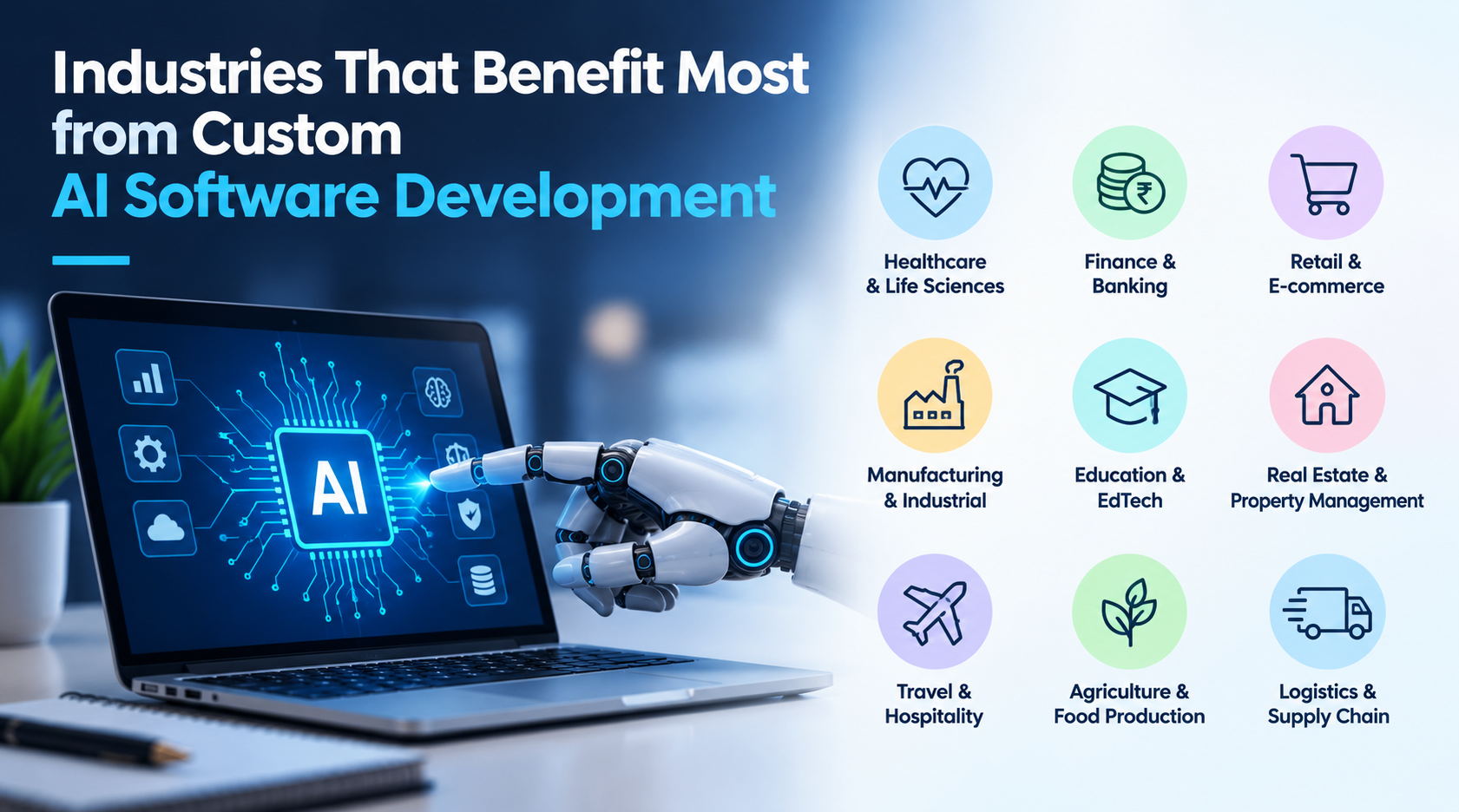
Which industries can benefit most from artificial intelligence? The industries that benefit most from custom AI software development are those that manage repetitive tasks, process large volumes of information, or need to make decisions using complex data. Banking, healthcare, retail, manufacturing, logistics, agriculture, and education are among the sectors where AI can support practical business improvements.
Businesses across India are exploring Custom AI Software Development to improve operational efficiency, simplify workflows, and deliver better customer experiences. The right approach depends on the organisation's requirements, existing systems, data quality, and the problems it wants to solve.
Which Industries Gain the Most from Custom AI in India?
Banking, healthcare, retail, manufacturing, and logistics offer useful starting points because they involve document processing, customer interactions, repetitive decisions, or operational planning.
| Industry | Potential AI application | Business benefit |
|---|---|---|
| Banking and insurance | Document processing and fraud alerts | Better transaction monitoring |
| Healthcare | Appointment and administrative support | More organised workflows |
| Retail and e-commerce | Customer support and product recommendations | Improved customer service |
| Manufacturing | Quality inspection and maintenance monitoring | Better production oversight |
| Logistics | Shipment tracking and route planning | More informed operational decisions |
| Agriculture | Crop monitoring and information services | Improved access to relevant insights |
| Education | Student support and content search | Easier access to information |
How Should Businesses Identify the Right AI Opportunity?
Businesses should consider data availability, workflow complexity, the importance of human oversight, and whether results can be measured. A well-defined process with clear inputs and outputs is generally a better starting point than an unclear business problem.
What Is Custom AI Software Development, and When Is It Necessary?
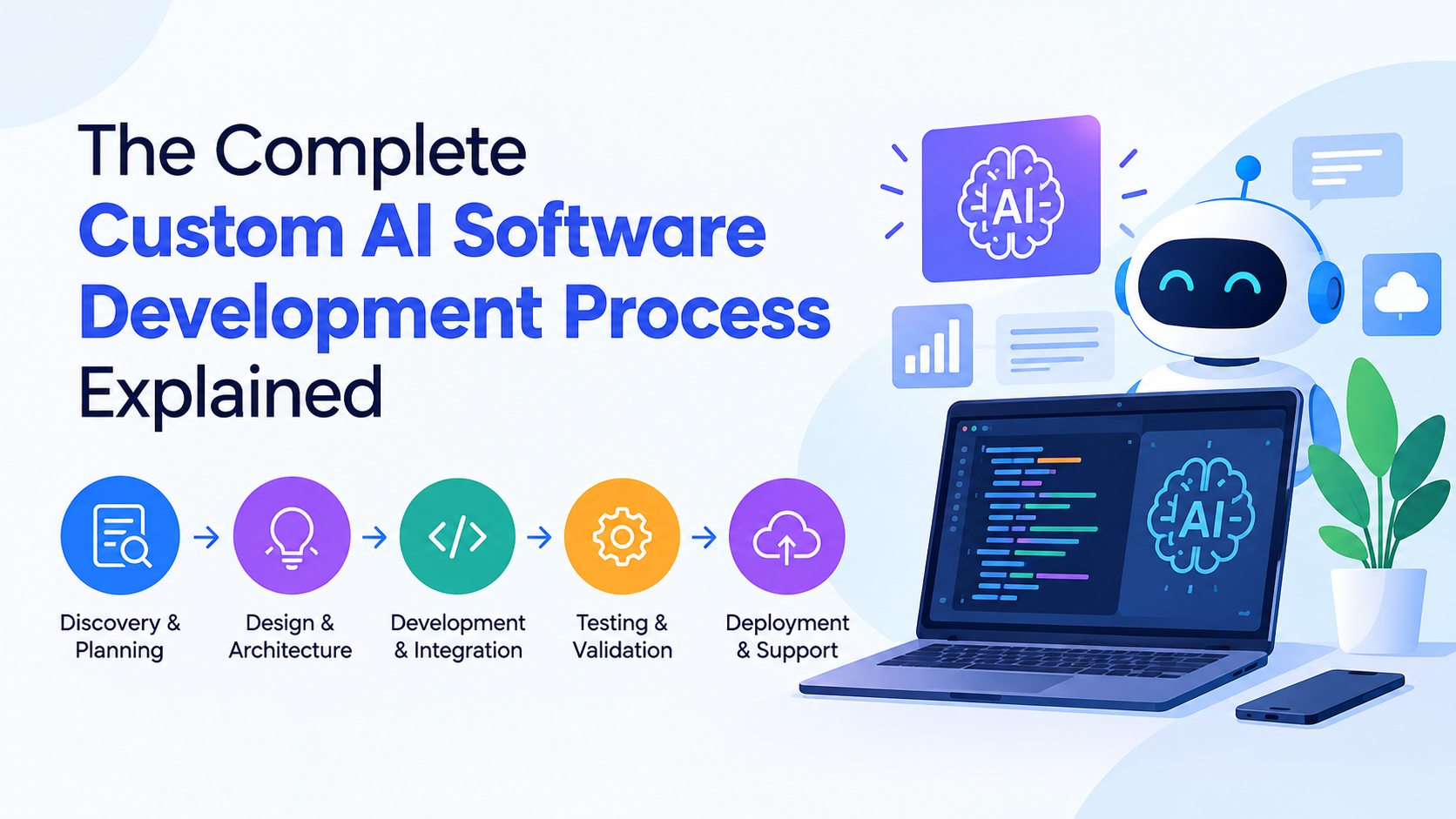
Custom AI software development involves building or adapting software to address a specific business requirement using technologies such as machine learning, natural language processing, computer vision, and generative AI.
For example, a distributor may need an application that reads purchase orders, checks product information, and transfers verified details into an inventory system.
Is Custom AI Better Than Ready-Made Software?
Not always. Ready-made tools work well when they provide the required functionality. Custom development becomes useful when existing applications cannot adequately support specialised workflows, complex integrations, or particular data requirements.
Before choosing a custom approach, businesses should define the problem, review available data, assess existing tools, and identify how success will be measured.
Why Does AI Implementation in India Require Special Consideration?
Indian businesses serve customers across different languages, regions, and digital environments. An effective AI application should reflect these practical requirements.
How Do Data Protection Requirements Affect AI Projects?
Businesses handling personal information should assess applicable requirements under India's Digital Personal Data Protection framework and any relevant sector-specific rules. Important considerations include data access, security, retention, permitted processing, and third-party services.
Organisations can consult the Ministry of Electronics and Information Technology for official information and seek appropriate legal guidance when required.
Why Are Indian Languages Important?
AI applications may need to support Malayalam, Hindi, Tamil, Telugu, Bengali, and other Indian languages. Language support should be tested using real customer enquiries, regional expressions, and different speech patterns rather than assumed from a product's advertised capabilities.
How Should Businesses Handle Existing Systems?
AI may need to integrate with customer relationship management software, accounting applications, internal databases, messaging platforms, and enterprise systems. Planning these connections early can help prevent disconnected workflows and unnecessary duplication.
Which Industries Benefit Most from Custom AI in India?
How Can Banking, Financial Services, and Insurance Use AI?
Banks, NBFCs, fintech companies, and insurance providers process financial records and customer information every day.
Applications: Document classification, customer enquiry handling, transaction monitoring, and claims administration.
Why customisation helps: Organisations may require specialised workflows and connections to internal systems.
Important considerations: Assess applicable RBI, SEBI, IRDAI, and other relevant requirements. Keep human oversight for sensitive financial decisions.
A practical first project could organise incoming documents and flag missing information for employee review.
How Can Healthcare, Diagnostics, and Pharma Benefit?
Healthcare organisations manage appointments, patient enquiries, reports, and administrative records.
Applications: Appointment management, document organisation, administrative assistance, and patient-service chatbots.
Why customisation helps: Hospitals, laboratories, and pharmaceutical businesses have different operational requirements.
Important considerations: Protect sensitive information and ensure that clinical decisions remain under appropriate professional supervision.
For example, a diagnostic centre could automate document classification while allowing staff to verify the information before it enters official records.
Why Is AI Useful for Retail, E-Commerce, and D2C Businesses?
Retailers manage product information, customer questions, orders, returns, and inventory.
Applications: Product recommendations, enquiry classification, inventory forecasting, and order-status assistance.
Why customisation helps: Businesses may operate across multiple sales channels with different product catalogues and workflows.
Important considerations: Validate recommendations, protect customer data, and maintain reliable order-processing controls.
An online retailer could start by directing customer enquiries to the appropriate support team.
How Can Manufacturing and MSME Factories Use AI?
Manufacturers handle production schedules, equipment records, inspection reports, and maintenance information.
Applications: Quality inspection, maintenance monitoring, production-report analysis, and document processing.
Why customisation helps: Equipment, production methods, and quality requirements differ between factories.
Important considerations: Test the system under real operating conditions and review outputs before using them in critical processes.
A factory could begin by analysing maintenance records to identify recurring equipment problems.
Can AI Improve Logistics and Supply Chain Operations?
Logistics companies coordinate deliveries, warehouse activities, shipment records, and vehicle schedules.
Applications: Shipment tracking, route-planning assistance, delivery-document processing, and demand forecasting.
Why customisation helps: Routes, delivery restrictions, and warehouse procedures vary by organisation.
Important considerations: Use reliable operational data and provide human intervention when unexpected disruptions occur.
An AI system could flag shipments that may be delayed so the operations team can investigate and respond.
How Can Agriculture and Agritech Benefit?
Agricultural businesses can use AI to support crop monitoring, agricultural information services, and analysis of field data.
Applications: Crop-condition monitoring, image-based identification assistance, and agricultural advisory tools.
Why customisation helps: Local crops, weather conditions, language requirements, and farming practices influence the solution.
Important considerations: Validate recommendations using reliable agricultural knowledge and local conditions.
A multilingual agricultural assistant could help farmers access verified guidance and direct complex questions to qualified specialists.
Why Should Education and Edtech Businesses Consider AI?
Educational institutions manage student enquiries, course information, learning resources, and administrative records.
Applications: Student-support assistants, learning-resource search, content classification, and administrative automation.
Why customisation helps: Institutions follow different curricula, academic policies, and learning-management processes.
Important considerations: Protect student information and review AI-generated educational content.
A college could use an assistant to answer routine questions using approved institutional information.
What Other Industries Can Benefit From AI?
Real estate: AI can organise property enquiries, classify documents, and help staff respond to prospective customers.
Legal services: AI can assist with document search and preliminary summaries, with qualified professionals checking the results.
Human resources: AI can help organise applications and schedule interviews, while hiring decisions remain subject to appropriate human review.
Media and government services: AI can support content classification, document workflows, and responses to routine public enquiries, with suitable safeguards for accuracy and privacy.
How Can Businesses Choose the Right AI Application?
The most suitable application depends on the organisation's size, operational challenges, data readiness, and existing software.
What Should Startups and Growing Businesses Automate First?
Startups may begin with customer enquiry classification, document organisation, or internal information retrieval. Growing businesses may consider connecting sales, customer support, inventory, and reporting processes.
Larger organisations may benefit from specialised applications that connect several departments, provided appropriate governance and integration practices are in place.
Should a Business Build, Buy, or Combine AI Tools?
Choose ready-made software when it meets the requirements. Consider custom development when existing products cannot adequately support the workflow. A hybrid approach may combine established applications with custom AI features.
The best decision comes from comparing actual business needs rather than choosing technology simply because it is new.
How Can Businesses Measure AI Results?
Businesses should define success before implementing a solution. Useful indicators include:
- Time required to complete a task.
- Accuracy and frequency of corrections.
- Number of documents or enquiries processed.
- Workflow completion and exception rates.
- Customer response times and satisfaction.
- Employee adoption and feedback.
For example, a service business could compare the time spent sorting customer enquiries before and after introducing an AI classification system. It should also check whether enquiries are routed correctly and whether employees need to correct the results.
A limited pilot helps determine whether the system works reliably in real operating conditions before it is introduced more widely.
How Can Businesses Choose a Custom AI Development Partner in India?
Selecting a development partner requires an understanding of both technology and business operations.
What Should Businesses Check Before Choosing a Provider?
Review relevant project experience, technical capabilities, data-security practices, integration expertise, and ongoing support arrangements. Ask who owns the source code and custom-developed components and how business information will be handled.
Request a demonstration of a relevant workflow and ask how the provider will test accuracy, handle errors, and measure results. Be cautious of providers that promise perfect performance or recommend AI without understanding the underlying problem.
What Steps Should Businesses Follow to Implement AI?
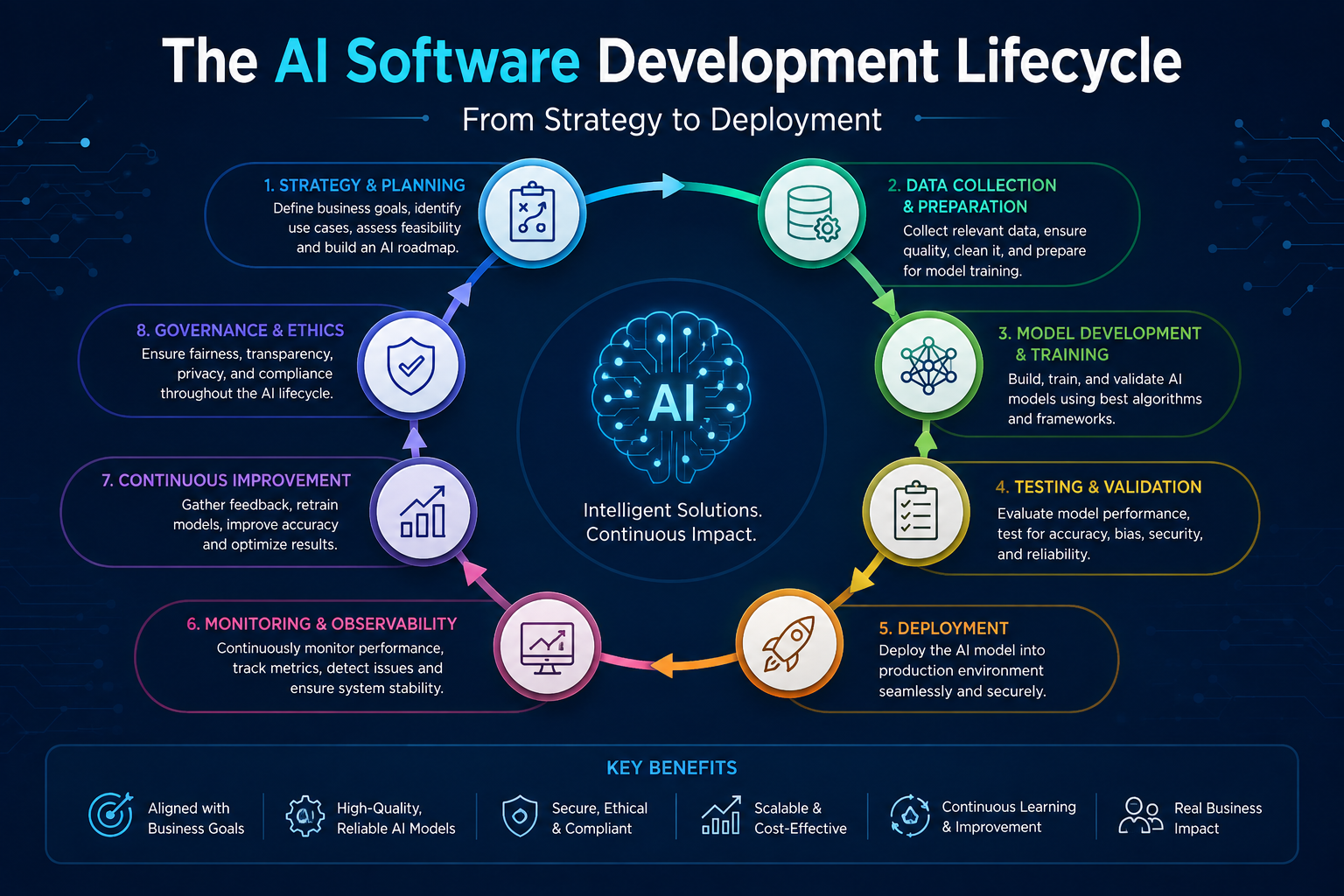
Step 1: Define the Problem
Document the existing workflow, identify bottlenecks, and establish measurable objectives.
Expected outcome: A clear problem statement and defined requirements.
Step 2: Review Data and Systems
Identify relevant documents, databases, applications, and access restrictions.
Expected outcome: A data-readiness assessment and integration plan.
Step 3: Build a Pilot
Develop a limited version of the proposed application using representative data.
Expected outcome: A working solution that can be evaluated against the intended use case.
Step 4: Test With Real Users
Assess accuracy, usability, security, and exception handling. Gather feedback from the employees who will use the system.
Expected outcome: Documented test results and identified improvements.
Step 5: Deploy and Monitor
Introduce the solution with appropriate training and human oversight. Monitor performance and update the system as business requirements change.
Expected outcome: A supported workflow with clear responsibilities and measurable performance indicators.
What Common AI Implementation Mistakes Should Businesses Avoid?
Why Should Businesses Start With a Problem Instead of a Tool?
Choosing technology before identifying the actual challenge can create unnecessary complexity. Businesses should define the desired outcome and then evaluate appropriate solutions.
Why Should Data Protection Be Considered Early?
Privacy, access permissions, and security requirements should be assessed during planning rather than left until deployment. Early consideration can help avoid unnecessary redesign.
Why Is Testing Important?
A system may perform well during a demonstration but struggle with poor-quality documents, unfamiliar language patterns, or unusual requests. Testing with representative examples helps identify these limitations.
Should Employees Be Involved?
Yes. Employees understand daily workflows and can identify practical problems that technical testing may overlook. Their feedback also helps ensure that the application fits the way the organisation works.
How Can Businesses Prepare for the Future of AI?
AI can help organisations improve workflows, organise information, and support better business decisions when applied to clearly defined challenges. The Future of AI will bring new opportunities, but successful adoption still requires reliable data, practical testing, appropriate security, and human oversight.
Businesses should start with one meaningful problem, assess available solutions, and expand only when the results support doing so. A well-planned AI solution should fit the organisation's objectives and help employees work more effectively.
Voicene delivers AI, IT, data, SEO, and digital solutions that help businesses automate operations, improve customer experiences, and drive growth.
If your organisation is exploring AI adoption, identify a workflow that needs improvement and discuss your requirements with the Voicene team.
Explore Voicene's technology and digital solutions to find an approach suited to your business needs.
Frequently Asked Questions About AI Across Industries
There is no single answer for every business. Banking, healthcare, retail, manufacturing, and logistics have promising applications, but the best opportunity depends on the specific workflow, available data, and business objectives.
Recent Blogs