The AI Software Development Lifecycle: From Strategy to Deployment
September 14, 2026
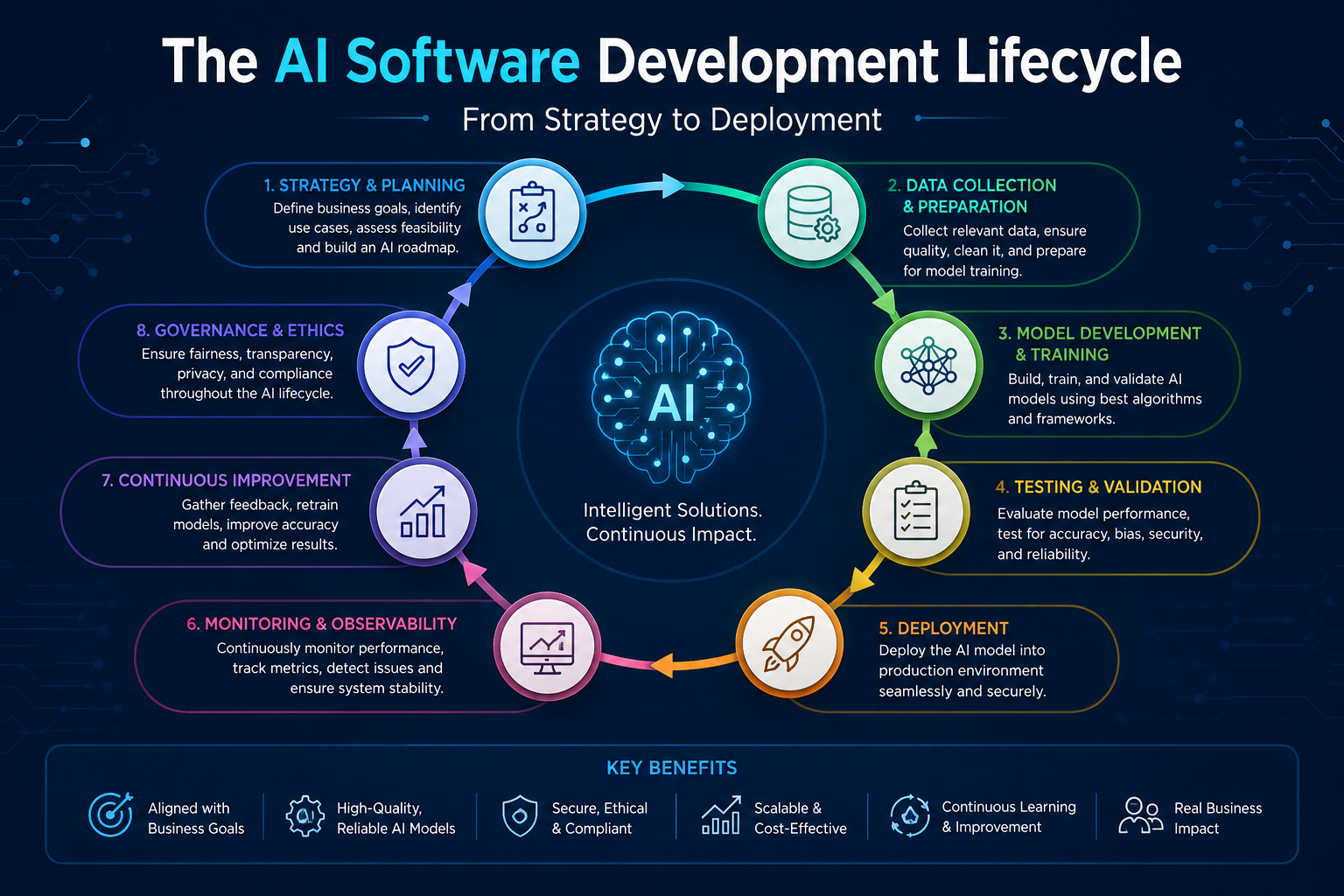
The AI Software Development Lifecycle: From Strategy to Deployment is the structured process of turning an AI idea into a reliable, production-ready solution. Unlike conventional software, AI systems depend on data, models, testing, monitoring, and continuous improvement.
For businesses working with AI Software Development Services, understanding this lifecycle helps reduce development risks, establish realistic goals, and create systems that can adapt as business requirements and data change.
Shifting from Deterministic Logic to Probabilistic Systems
Traditional applications generally follow predefined rules. AI applications often produce predictions or generated outputs based on patterns learned from data. This makes evaluation more complex because accuracy, reliability, bias, latency, and consistency all need to be considered.
From Point Solutions to End-to-End Workflows
Modern AI software development trends are moving beyond isolated AI features toward connected workflows. AI can support research, customer interactions, document processing, decision support, automation, and other business operations within a broader application.
What Are the 7 Phases of a Successful AI Lifecycle?
Phase 1: Business Alignment and Problem Definition
Every successful project begins with a clear business problem. Define the users, expected outcome, measurable success criteria, available resources, and acceptable risks before selecting a technology.
Phase 2: Data Engineering — The 80% Effort Rule
Data preparation can become one of the largest parts of an AI project. Teams need to collect, clean, label, structure, validate, and secure relevant data. Poor-quality data can undermine even a technically strong model.
Phase 3: Model Architecture and Build vs. Buy Decisions
The next step is selecting an appropriate technical approach. Depending on the project, organizations may use existing models, APIs, fine-tuning, retrieval-based systems, or custom models. A practical Ai product development company evaluates requirements, cost, performance, scalability, and maintenance before making this decision.
Phase 4: Iterative Training, Testing, and Validation
Models should be tested against representative data and clearly defined evaluation criteria. Testing should cover accuracy as well as security, reliability, response quality, edge cases, and real-world usability.
Phase 5: Deployment and Production Integration
A model becomes useful when it works reliably inside the actual product or workflow. Deployment may involve APIs, cloud infrastructure, databases, authentication, application interfaces, monitoring tools, and access controls.
Phase 6: Continuous Monitoring and Managing Model Drift
Model drift occurs when changes in real-world data reduce model performance. Monitoring helps identify declining accuracy, unexpected outputs, changing user behavior, latency issues, or other production problems.
Phase 7: Retraining and Improvement Loops
AI development does not necessarily end at launch. Feedback, new data, changing requirements, and performance measurements can inform future improvements and retraining cycles.
How Are AI Software Development Services Changing with Agentic AI?
The latest AI software development trends increasingly focus on systems that can perform multi-step tasks rather than simply respond to individual prompts.
From Copilots to Intelligent Teammates
AI applications are becoming capable of planning tasks, using tools, retrieving information, and coordinating multiple steps. Human oversight remains important, particularly for sensitive or high-impact decisions.
What Is the Inception-Construction-Operations Model?
A practical AI development approach can be viewed across three stages: defining the intended system, building and validating it, and operating it continuously. This keeps business objectives connected to technical implementation and post-launch improvement.
How Should Responsible AI Be Included in the Lifecycle?
Responsible AI should be considered throughout development rather than added immediately before launch.
How Can Data Poisoning and Model Inversion Risks Be Reduced?
Strong access controls, data validation, secure development practices, monitoring, privacy protections, and careful evaluation can help reduce security and privacy risks.
Why Do Governance and Compliance Matter?
AI systems may process sensitive information or influence important decisions. Clear documentation, human oversight, risk assessment, and applicable regulatory requirements should therefore be considered during architecture and deployment.
How Can AI Development Costs and ROI Be Estimated?
AI project costs depend on scope, data requirements, model strategy, infrastructure, integrations, security, testing, and ongoing maintenance. ROI should not be measured only by development cost. Businesses should also consider time saved, process efficiency, improved customer experiences, reduced manual work, and measurable business outcomes.
Voicene Technologies LLP, an AI-focused software development company headquartered in Kazhakuttam, Thiruvananthapuram, Kerala, India, approaches AI development with a lifecycle-oriented perspective from understanding the business requirement through development, deployment, and continuous improvement.
Conclusion
The AI Software Development Lifecycle: From Strategy to Deployment provides a practical framework for building AI solutions that are useful beyond the prototype stage. Business alignment, quality data, appropriate model selection, rigorous testing, secure deployment, monitoring, and continuous improvement all contribute to long-term success.
For organizations exploring AI Software Development Services, AI web development, or AI-powered products, treating development as an ongoing lifecycle rather than a one-time build can create a stronger foundation for sustainable innovation.
Frequently Asked Questions
Recent Blogs