Common Challenges of AI Adoption and How to Overcome Them
September 14, 2026
AI Adoption Has Gone Mainstream — But Success Hasn't
AI adoption is no longer a question of "if." Businesses across industries are increasingly exploring artificial intelligence to automate processes, improve decision-making, enhance customer experiences, and create new efficiencies.
However, experimenting with AI and successfully integrating it into everyday business operations are two very different things.
For many organizations, technology itself isn't the biggest obstacle. Limited budgets, a shortage of skilled talent, data quality issues, security concerns, employee resistance, legacy infrastructure, and uncertainty around return on investment can all prevent an AI initiative from moving beyond the pilot stage.
For business leaders, IT decision-makers, and entrepreneurs, understanding these challenges and having a practical plan to address them can make the difference between an AI project that remains an experiment and one that delivers measurable business value.
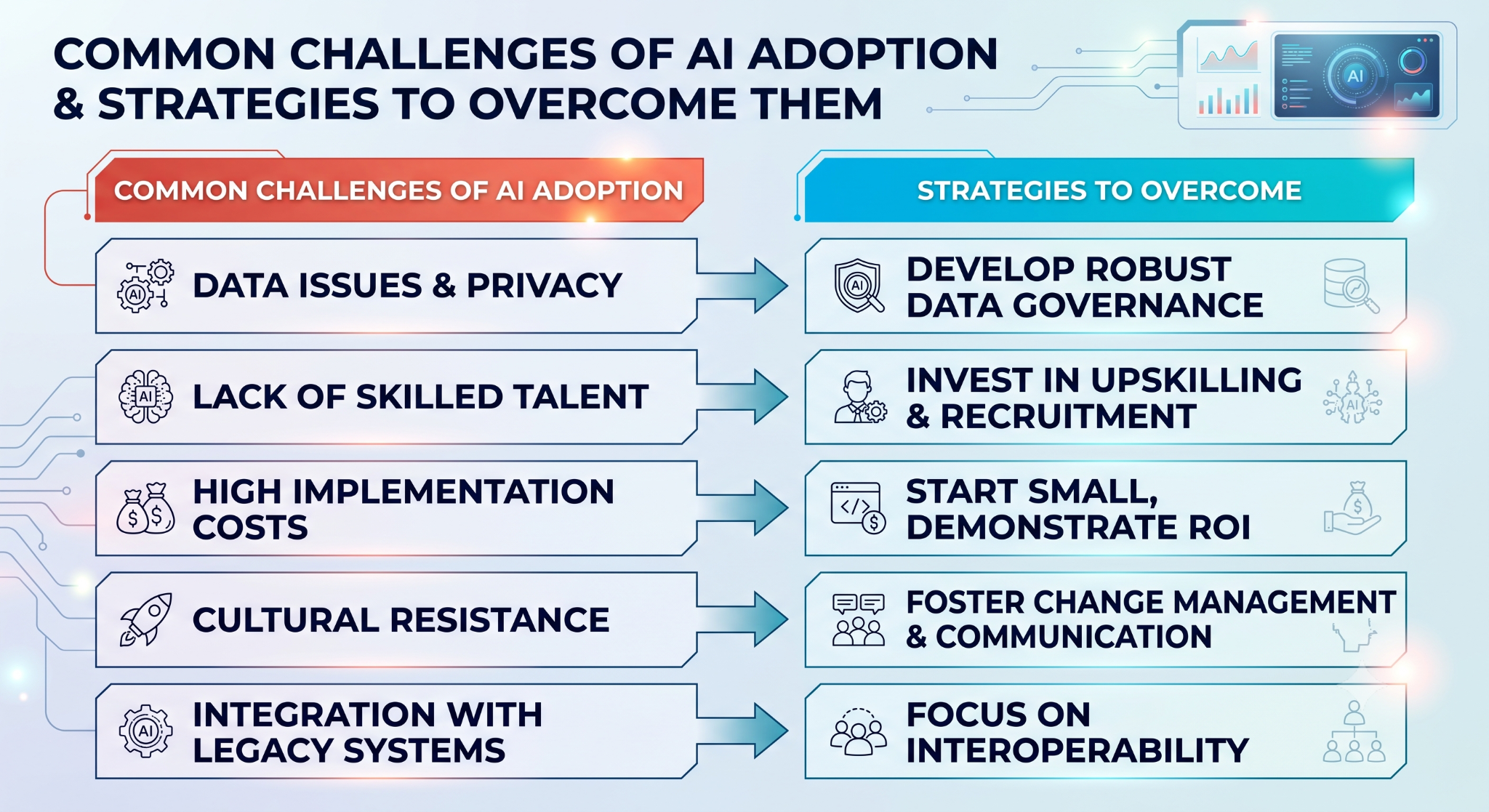
Below are seven of the most common challenges businesses face when adopting AI, along with practical ways to overcome each one.
1. High Implementation Costs
Building, integrating, and maintaining AI systems can require significant investment in infrastructure, software, licensing, development, data preparation, and ongoing maintenance. For small and mid-sized businesses in particular, the perceived upfront cost can be enough to delay an otherwise valuable project.
How to overcome it:
- Start with a focused pilot or proof of concept. Test AI on one specific workflow instead of attempting an organization-wide rollout from day one.
- Use cloud-based AI services where appropriate. Cloud solutions can reduce the need for large upfront investments in infrastructure and allow businesses to scale their spending as their needs grow.
- Set a clear pilot budget. Establish spending limits and define the results that would justify moving to the next stage.
- Build a business case around measurable outcomes. Identify the potential time savings, cost reduction, revenue growth, or efficiency improvements before committing to a larger investment.
Example: A mid-sized logistics company could begin by testing an AI-powered route optimization system at a single regional hub rather than deploying it across the entire organization. A limited pilot allows the company to evaluate the technology, identify operational issues, and measure potential savings before making a larger investment.
2. Lack of Skilled Talent
Successful AI implementation requires a combination of technical expertise and business knowledge. Data scientists, machine learning engineers, developers, and AI-literate product professionals can be difficult and expensive to recruit, particularly for small and mid-sized businesses.
However, hiring an entire AI team isn't always necessary.
How to overcome it:
- Upskill existing employees. Employees who already understand the business can become effective AI users with the right training.
- Build AI literacy across departments. Not every employee needs to become an AI engineer. They need to understand how AI can be applied to their specific responsibilities and workflows.
- Work with external specialists. AI consultants, technology partners, and implementation teams can provide expertise without requiring a business to build an entire internal team immediately.
- Develop internal capabilities over time. External support can help businesses get started while employees gradually develop the skills needed to manage and improve AI systems.
The goal isn't necessarily to hire more people. It's to combine existing business knowledge with the right technical expertise.
3. Data Privacy and Security Concerns
AI systems often rely on significant amounts of business and customer data. This can include personal information, financial records, internal documents, customer communications, and proprietary business information.
Using such data without appropriate safeguards can create security, compliance, and reputational risks.
How to overcome it:
- Establish data governance before scaling an AI project. Define what data can be used, who can access it, and how it should be stored and processed.
- Minimize sensitive data exposure. Only provide AI systems with the information they actually need for a specific task.
- Use appropriate security measures. Encryption, access controls, authentication, monitoring, and secure data handling should be considered from the beginning.
- Evaluate AI vendors carefully. Understand how providers handle, store, and protect customer data before integrating their services into business workflows.
- Review applicable compliance requirements. Depending on the business and location, privacy and data protection regulations may impose specific requirements on how information is collected and processed.
Security shouldn't be something added after an AI system is already operational. It should be part of the implementation strategy from the start.
4. Employee Resistance to Change
AI adoption changes how people work. This can naturally create uncertainty, particularly when employees worry that automation could make their roles less important or even replace them.
Even technically sound AI projects can struggle if the people expected to use them don't trust or understand the technology.
How to overcome it:
- Communicate early. Explain why AI is being introduced, what problem it is intended to solve, and how employees will be affected.
- Involve employees in the process. Frontline employees often understand operational challenges better than anyone else and can help identify where AI would actually be useful.
- Focus on augmentation rather than replacement. Show employees how AI can reduce repetitive work and allow them to spend more time on higher-value activities.
- Provide practical training. Training should focus on real workflows and tasks rather than generic AI theory.
- Share early successes. Demonstrating tangible improvements can help build confidence and encourage wider adoption.
People are more likely to embrace new technology when they understand how it helps them rather than simply being told that they need to use it.
5. Poor Data Quality
One of the most underestimated barriers to successful AI adoption is poor-quality data.
Many businesses work with information that is incomplete, inconsistent, outdated, duplicated, or poorly structured. Since AI systems depend heavily on the information they receive, unreliable data can lead to unreliable results.
Even sophisticated AI cannot compensate for fundamentally poor inputs.
How to overcome it:
- Audit your data before selecting an AI use case. Understand what information is available, how reliable it is, and where gaps exist.
- Establish ongoing data cleansing and validation. Data quality should be monitored continuously rather than treated as a one-time cleanup exercise.
- Standardize data collection at the source. Consistent processes can prevent quality problems from spreading throughout the organization.
- Start with reliable datasets. Where possible, choose an initial AI project that uses data the business already understands and trusts.
- Address data gaps gradually. Businesses don't necessarily need perfect data before starting. They need to understand its limitations and choose a realistic use case.
The goal isn't to wait for perfect data. It's to understand your data well enough to know what AI can realistically do with it.
6. Integration With Legacy Systems
Many businesses rely on software and infrastructure that was implemented years, sometimes decades, ago. These systems may still be critical to daily operations but weren't necessarily designed to work with modern AI applications.
Replacing everything at once can be expensive, disruptive, and unnecessary.
How to overcome it:
- Audit existing systems first. Identify where AI tools can integrate with current infrastructure and where deeper modernization may be required.
- Use APIs and middleware where appropriate. These can allow new AI applications to communicate with existing systems without immediately replacing them.
- Start with one integration. Prove that the AI solution works alongside existing technology before expanding it across the organization.
- Modernize gradually. Legacy modernization can happen alongside AI adoption rather than becoming a prerequisite for starting.
- Prioritize based on business impact. Focus modernization efforts on the systems creating the greatest operational limitations.
AI adoption doesn't always require a complete technology overhaul. In many cases, the better approach is to build a bridge between existing systems and new capabilities.
7. Unclear Return on Investment (ROI)
One of the biggest challenges businesses face is determining whether an AI investment is actually delivering enough value to justify its cost.
Some benefits, such as reduced processing time or lower operating costs, can be measured relatively easily. Others, such as improved customer experience, better decision-making, or employee productivity, may take longer to quantify.
Without clear metrics, AI projects can continue consuming resources without providing a clear understanding of their impact.
How to overcome it:
- Define KPIs before implementation. Decide what success looks like before launching the project.
- Measure financial and operational outcomes. Track metrics such as cost savings, time saved, revenue generated, conversion rates, productivity, or customer satisfaction.
- Set regular review points. Evaluate progress at defined intervals rather than waiting until the end of the project.
- Compare results against the original business case. Determine whether the AI system is delivering the improvements that justified the investment.
- Be willing to change direction. If a project isn't producing meaningful results, improve it, change the use case, or stop it rather than continuing simply because resources have already been invested.
AI shouldn't be adopted simply because it is technologically impressive. It should solve a real business problem and produce measurable value.
How Voicene Technologies Helps Businesses Overcome AI Adoption Challenges
Understanding the challenges of AI adoption is one thing. Having the expertise to navigate them in practice is another.
For small and mid-sized businesses, building a large in-house AI team may not always be practical. A technology partner can provide access to the expertise needed to identify opportunities, develop solutions, integrate systems, and measure results without requiring a business to build everything internally.
At Voicene Technologies, the approach is to help businesses adopt technology strategically and practically, with a focus on solving real business problems.
Managing Costs
Rather than pushing businesses toward large-scale implementations immediately, AI initiatives can be approached in phases. Starting with a focused use case — such as customer support automation, lead qualification, workflow automation, or intelligent data processing — allows businesses to demonstrate value before committing to larger investments.
Bridging the Talent Gap
Businesses don't always need to hire an entire team of AI specialists to get started. Working with an experienced technology partner can provide access to technical, data, and implementation expertise while allowing internal teams to build their capabilities over time.
Protecting Data and Privacy
AI solutions need to be designed with data security and responsible data handling in mind. Understanding what information is being processed, where it is stored, who can access it, and how it is used should be part of the planning process from the beginning.
Integrating With Existing Technology
AI solutions rarely operate in isolation. They often need to work alongside existing CRMs, ERPs, websites, databases, and other business applications. Voicene Technologies can approach AI implementation with integration in mind, helping businesses introduce new capabilities without unnecessarily replacing systems that already work.
Keeping ROI at the Center
AI projects should ultimately contribute to business outcomes. By defining measurable objectives and tracking performance, businesses can evaluate whether an AI initiative is creating genuine value rather than simply adding another piece of technology to their existing stack.
The common thread is simple: successful AI adoption isn't just about choosing the right technology. It's about choosing the right problem, preparing the business, implementing carefully, and measuring what happens next.
Treat AI Adoption as a Strategic Journey, Not a Tech Purchase
AI adoption is becoming an increasingly important part of how businesses improve efficiency, make decisions, and create better customer experiences. But successful adoption requires more than simply choosing an AI tool.
Businesses that get the most value from AI are the ones that plan for the challenges from the beginning — starting with focused use cases, investing in people alongside technology, protecting data, involving employees, working with existing infrastructure, and measuring results against clear business objectives.
AI adoption isn't a single project with a finish line. It's an ongoing capability that becomes more valuable as businesses learn where technology can solve real problems and deliberately build it into their operations.
The goal isn't to adopt AI simply because everyone else is doing it. The goal is to identify where AI can create meaningful value for your business — and build from there.
Not sure where AI could fit into your business? Voicene Technologies can help you identify practical opportunities, evaluate your existing systems and data, and develop an AI roadmap focused on measurable business outcomes.
Frequently Asked Questions (FAQ)
Recent Blogs