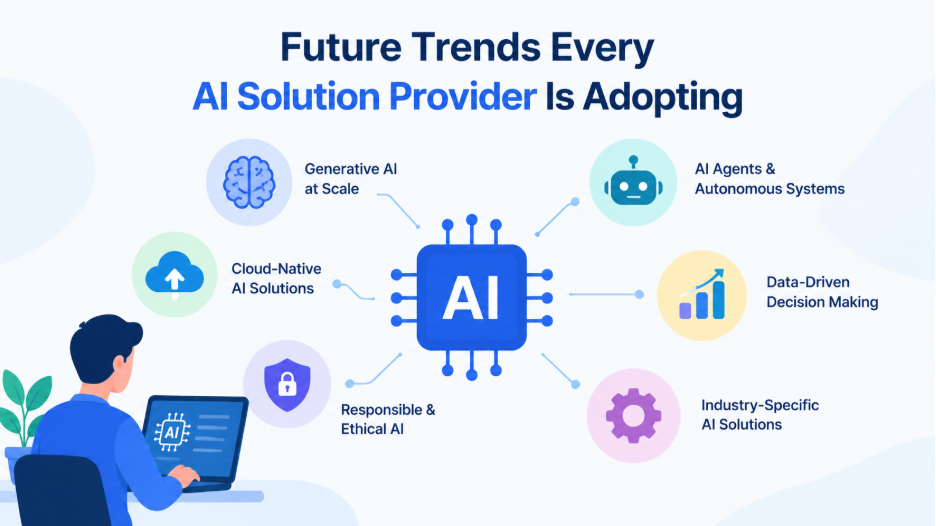
Future Trends Every AI Solution Provider Is Adopting
Artificial intelligence is moving from experimental projects to practical business systems. Companies are using AI to automate repetitive work, understand data, improve customer support and create more personalised digital experiences. For businesses planning an AI project, choosing an ai solution provider is no longer simply about selecting a tool with the latest model. The provider's approach to security, integration, scalability, language support and long-term innovation also matters.
India's AI ecosystem is developing across startups, enterprises, research institutions and government-backed initiatives. The IndiaAI Mission, for example, includes initiatives covering compute infrastructure, datasets, application development, skills, startup support and safe and trusted AI.
So, what trends should businesses look for when evaluating an AI provider?
Why Do AI Provider Trends Matter Before You Buy in India?
An AI project can continue for years after the initial implementation. A provider that only solves today's requirement may become difficult to work with as data volumes, customer expectations and business processes change.
What should businesses evaluate?
Look beyond the current feature list. Consider:
- AI automation capabilities
- Data protection and security
- API and software integrations
- Human oversight
- Model flexibility
- Indian language support
- Pricing transparency
- Technical support
- Scalability
For Indian businesses, local requirements can also influence the choice. Language diversity, regional customer behaviour, GST-related workflows and different levels of digital adoption can all affect how an AI system should be designed.
What Is Agentic AI and Why Is It Becoming Important?
Agentic AI refers to AI systems that can perform a sequence of tasks toward a defined objective rather than simply responding to one prompt.
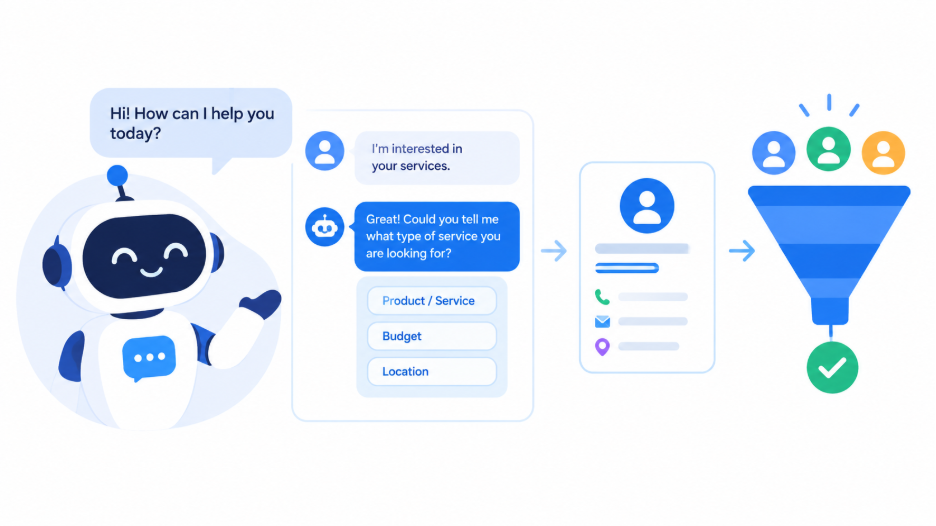
For example, an AI workflow could receive a customer enquiry, identify the customer's requirement, retrieve information from a business system, prepare a response and send the conversation to a human employee when approval is required.
Where can businesses use agentic AI?
Common applications include:
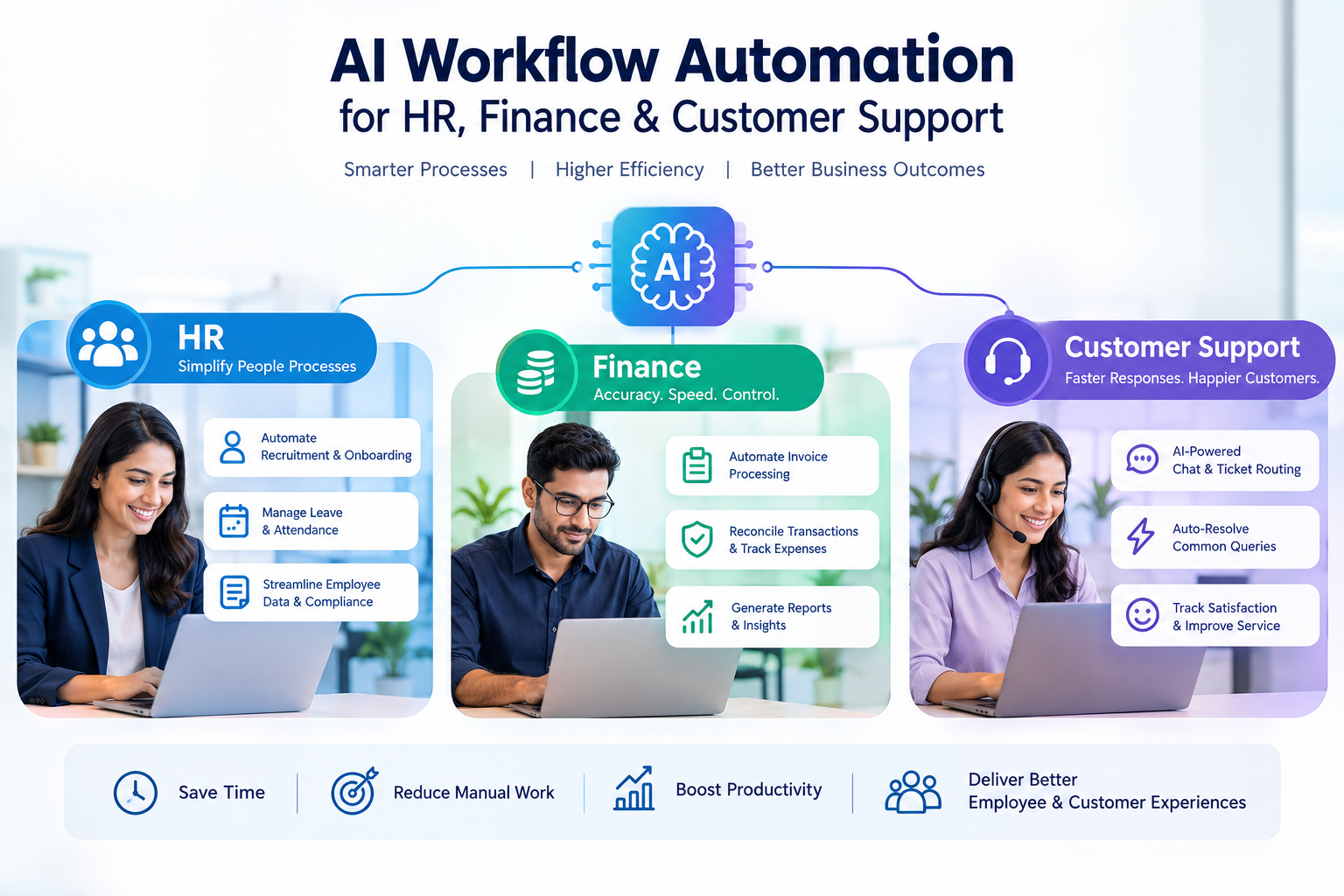
- Customer support
- Sales follow-ups
- Invoice processing
- HR workflows
- Lead qualification
- Internal knowledge search
- Document processing
When evaluating an ai solution provider, businesses should ask how the provider handles permissions, errors, human approval and auditability. Automation should not mean removing human control from important business decisions.
Why Are Indic Languages and Voice AI Becoming Major Trends?
India's language diversity creates opportunities for AI systems that can understand more than English. Hindi, Tamil, Malayalam, Bengali, Telugu, Marathi and other regional languages can be important for customer service and public-facing applications.
Voice technology is particularly useful where typing is inconvenient or where customers are more comfortable speaking than writing.
What should you test?
Do not judge language support from a feature list alone. Test real customer conversations, accents, background noise and code-mixed communication such as Hinglish or Manglish.
A good provider should be able to demonstrate how its system handles the actual language patterns used by your customers.
How Important Are Data Privacy and AI Security?
Security is becoming a central part of AI adoption. India's Digital Personal Data Protection Act, 2023 establishes requirements concerning the processing of digital personal data, while the Digital Personal Data Protection Rules, 2025 were notified by MeitY in November 2025.
Businesses should therefore ask an AI provider:
- Where is business data stored?
- Is customer data used for model training?
- What encryption is provided?
- Who can access the information?
- Are audit logs available?
- How are deleted records handled?
- What happens when the contract ends?
For sensitive projects, privacy and security requirements should be reviewed before implementation rather than after deployment.
Why Are Domain-Specific AI Models Growing?
General-purpose AI can be useful, but businesses often need systems that understand their own terminology, documents and processes.
A healthcare organisation may need medical terminology. A financial company may require specialised financial workflows. A retailer may need product and inventory knowledge.
Techniques such as RAG, knowledge bases and model customisation allow AI applications to work with company-specific information without relying entirely on generic knowledge.
Should every business build a custom model?
No. A small company with a straightforward requirement may benefit from an existing model combined with a well-designed workflow. A larger organisation with specialised data and complex requirements may need deeper customisation.
The right approach depends on the use case, data, budget and operational requirements.
What Is Multimodal AI?
Multimodal AI can work with different types of information, including text, images, audio and video.
This opens up practical business applications such as:
- Reading invoices
- Extracting information from documents
- Analysing product photographs
- Summarising meetings
- Processing voice recordings
- Creating video summaries
- Understanding scanned forms
For Indian businesses, document handling can be especially valuable because organisations often work with PDFs, scanned documents, regional-language content and mixed digital and paper workflows.
Why Are Smaller and Faster AI Models Becoming Popular?
Large models can provide powerful capabilities, but every business does not need maximum model size for every task.
Smaller models can potentially reduce latency, infrastructure requirements and operating costs. They may also be suitable for applications where connectivity is limited or where processing needs to happen closer to the user.
This is contributing to interest in efficient models, edge AI and on-device processing.
An experienced provider should be able to explain which model is appropriate for which task, instead of automatically recommending the largest available model.
Why Does Responsible AI Matter?
AI systems can produce inaccurate information, biased outputs or unsupported answers. Businesses therefore need controls around accuracy and accountability.
Important capabilities include:
- Human review
- Source citations
- Access controls
- Output monitoring
- Bias testing
- Hallucination reduction
- Audit trails
- Clear escalation procedures
The RBI has also highlighted issues including privacy, explainability, accountability, transparency and responsible AI adoption in financial services.
For regulated or high-impact applications, responsible AI should be treated as part of system design rather than an optional feature.
How Are Easy Integrations Changing AI Adoption?
Businesses rarely operate with one software platform. They may use WhatsApp, CRM systems, accounting software, ecommerce platforms, ERP systems and payment tools.
An ai solution provider that supports APIs, webhooks and no-code integrations can make implementation easier.
Potential integrations include:
- Tally
- Zoho
- Shopify
- CRM platforms
- ERP systems
- Payment-related workflows
The important question is not simply whether an integration exists. Ask how reliable it is, what data it can access and how much maintenance it requires.
Are Flexible Pricing Models Becoming More Important?
AI costs can vary significantly depending on model usage, number of users, integrations and data-processing requirements.
Providers may offer subscription, usage-based or pay-as-you-go pricing.
Before signing a contract, ask about:
- API or token charges
- Integration costs
- Setup fees
- Support tiers
- Additional users
- Data-storage charges
- Model upgrade costs
- Contract minimums
A pilot project can help businesses estimate actual usage before committing to a larger deployment.
How Can You Compare AI Solution Providers?
Create a simple evaluation checklist before scheduling vendor demonstrations.
| Evaluation area | Questions to ask |
|---|---|
| AI capabilities | Does it solve the actual business problem? |
| Automation | Can repetitive workflows be automated safely? |
| Security | How is business data protected? |
| Integration | Can it connect with existing software? |
| Language | Does it support the languages customers use? |
| Scalability | Can the solution grow with the business? |
| Support | What support and SLA are provided? |
| Pricing | Are all usage and integration costs clear? |
| Customisation | Can the solution adapt to business-specific data? |
| Governance | Are monitoring and human-review controls available? |
Ask for demonstrations using your own business workflow, rather than relying only on a generic product presentation.
Which AI Provider Type Is Suitable for Different Businesses?
A small business may prioritise affordability, simple automation and easy onboarding.
A mid-sized or enterprise organisation may require integrations, access controls, custom workflows, analytics and stronger governance.
Students, creators and individual users may prioritise accessibility, ease of use and flexible pricing.
India-built providers can offer familiarity with local business requirements and regional languages, while global platforms may provide access to broad ecosystems and mature international infrastructure. The appropriate choice depends on the specific requirements of the project.
What Common Mistakes Should Indian Businesses Avoid?
One common mistake is buying an AI product because it is popular rather than because it solves a clearly defined problem.
Other mistakes include:
- Ignoring data privacy
- Not checking integration requirements
- Choosing without testing
- Overlooking hidden costs
- Automating processes that still require human review
- Depending completely on one vendor
- Failing to define measurable outcomes
A small pilot can reveal many of these issues before a full-scale rollout.
What AI Trends Should Businesses Watch Beyond 2026?
AI development is likely to continue moving toward more capable agents, multimodal applications, efficient models, regional-language systems and stronger governance.
India is also investing in AI infrastructure, datasets, skills and responsible AI initiatives through the IndiaAI ecosystem. The IndiaAI Compute initiative is designed to provide access to AI compute resources for groups including startups, MSMEs, researchers, students and industry.
Businesses should therefore prepare not only by purchasing AI tools but also by developing internal AI skills and clear governance processes.
How Should You Prepare for the Future of AI?
The future of AI is not only about bigger models. Businesses are increasingly looking for systems that are useful, secure, integrated, explainable and adaptable.
When evaluating an ai solution provider, consider the complete picture: automation capabilities, regional-language support, data protection, domain customisation, multimodal AI, efficient models, responsible AI, integrations and transparent pricing.
Voicene Technologies LLP helps businesses explore AI, IT, data, SEO and digital solutions designed to improve operations, customer experiences and business growth. Instead of adopting AI simply because it is trending, businesses can start with a clearly defined problem, run a controlled pilot and measure the outcome before scaling.
Frequently Asked Questions
Start with the business problem rather than the trend. Automation, customer support, document processing and knowledge management can be practical starting points.
Recent Blogs