The Complete Custom AI Software Development Process Explained
Artificial intelligence is no longer limited to large technology companies. Businesses across India are using AI to automate repetitive work, understand customer behaviour, improve decision-making, reduce operational costs, and create better digital experiences. But choosing an AI tool is only the beginning. When a business needs an AI system built around its own data, workflows, and objectives, Custom AI Software Development becomes a more practical approach.
So, what does the complete AI development process look like? From identifying the right business problem to deploying and maintaining an AI solution, every stage requires careful planning. This guide explains the process, technologies, timelines, security considerations, and key factors businesses should consider before working with a custom AI development company.
What Is Custom AI Software Development?
Custom AI Software Development is the process of designing and building an artificial intelligence solution specifically for a company's business requirements.
Instead of using a generic AI application, a custom solution can be developed around proprietary business data, existing software, internal processes, customer requirements, and industry-specific objectives.
For example, an e-commerce company might require a recommendation engine that understands its own product catalogue and customer behaviour. A financial company may need an AI system for fraud detection, while a healthcare organisation may require an AI-assisted diagnostic workflow.
How Does It Differ From Off-the-Shelf AI Tools?
Off-the-shelf AI tools such as ChatGPT plugins, SaaS AI add-ons, and general-purpose automation platforms are designed for broad use cases. They can be excellent for content generation, customer support, research, and everyday productivity.
A custom solution becomes useful when a business needs deeper integration, proprietary data processing, specific workflows, specialised models, or greater control over security and infrastructure.
The choice should therefore depend on the business problem rather than simply choosing AI because it is a current technology trend.
Why Are Indian Businesses Choosing Custom AI Solutions?
Indian businesses are increasingly exploring AI because it can help them automate repetitive operations, improve customer service, analyse large datasets, and scale processes without increasing manual workload at the same rate.
AI is also becoming more accessible through cloud infrastructure, open-source frameworks, APIs, machine learning platforms, and large language models. This makes it possible for startups and SMEs to explore AI solutions without building every component from scratch.
What Are Common Misconceptions About Custom AI Development?
One common misconception is that every AI project requires training a completely new model. In reality, many projects can use existing foundation models, APIs, retrieval-augmented generation, machine learning frameworks, or fine-tuning.
Another misconception is that AI automatically solves business problems. A successful project starts with a clearly defined business objective, reliable data, measurable KPIs, and a realistic implementation plan.
Who Needs Custom AI Software?
Almost any industry can benefit from a properly designed AI application when there is a clear business use case.
How Can E-commerce and D2C Brands Use AI?
E-commerce businesses can use AI for product recommendations, conversational shopping assistants, customer segmentation, demand forecasting, and automated customer support.
How Is AI Used in Fintech and NBFCs?
Financial organisations can explore AI for fraud detection, risk analysis, document processing, customer support, and credit assessment. Because financial data is sensitive, security, explainability, and regulatory requirements should be considered from the beginning.
Can Healthcare Businesses Use AI?
Yes. Healthcare organisations can use AI-assisted screening, medical image analysis, appointment automation, clinical documentation, and patient-support applications. Such systems require careful validation and appropriate human oversight.
How Can EdTech Companies Benefit From AI?
AI can support personalised learning, automated assessments, intelligent tutoring, content recommendations, and student engagement analysis.
What About Manufacturing and Logistics?
Manufacturing businesses can use AI for predictive maintenance, quality inspection, demand forecasting, inventory planning, and production optimisation. Logistics companies can apply AI to route optimisation, delivery forecasting, and fleet management.
How Can Real Estate and PropTech Companies Use AI?
Real estate platforms can use AI for lead scoring, property recommendations, automated responses, document analysis, and virtual assistants.
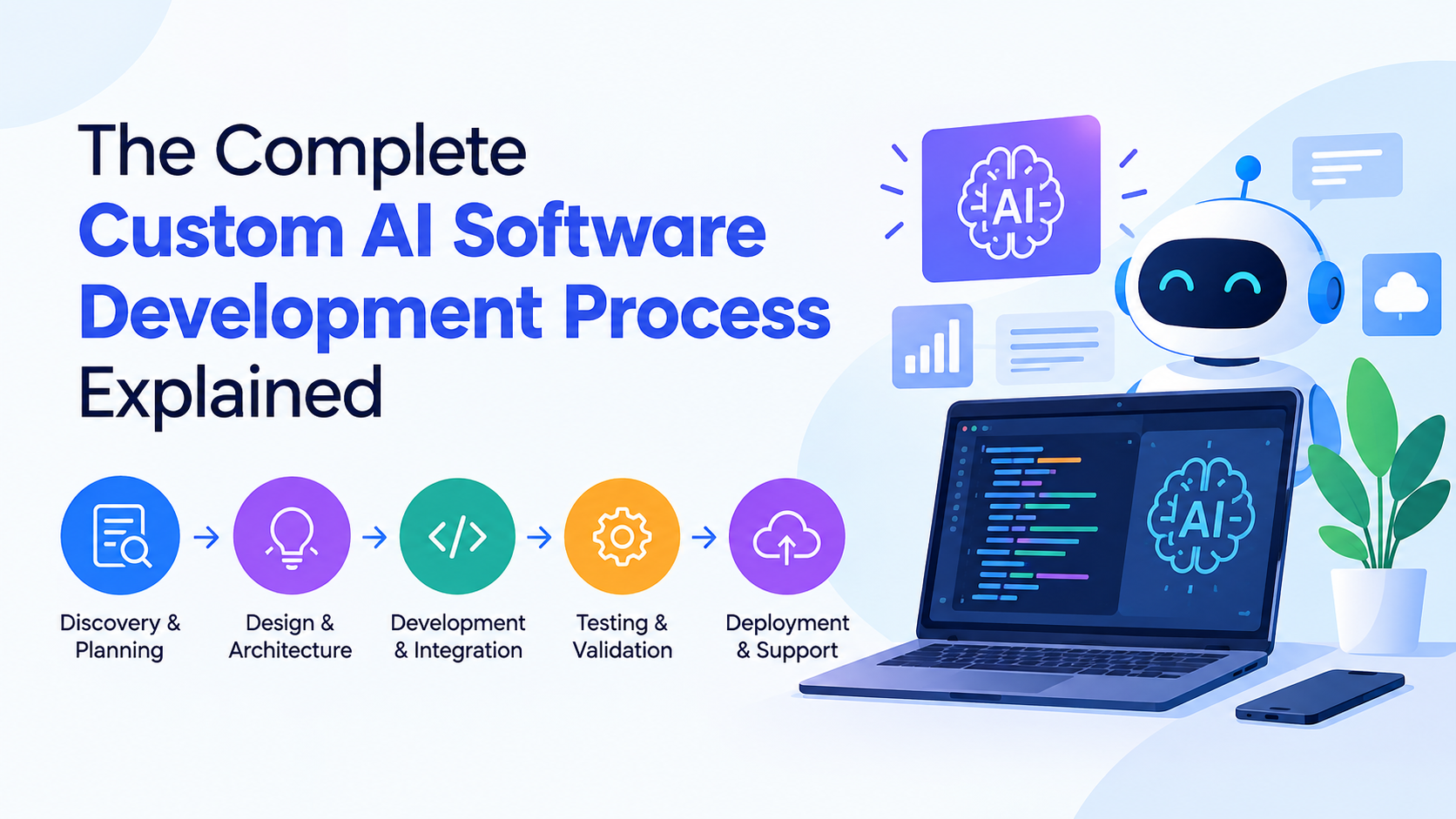
What Is the Complete Step-by-Step AI Development Process?
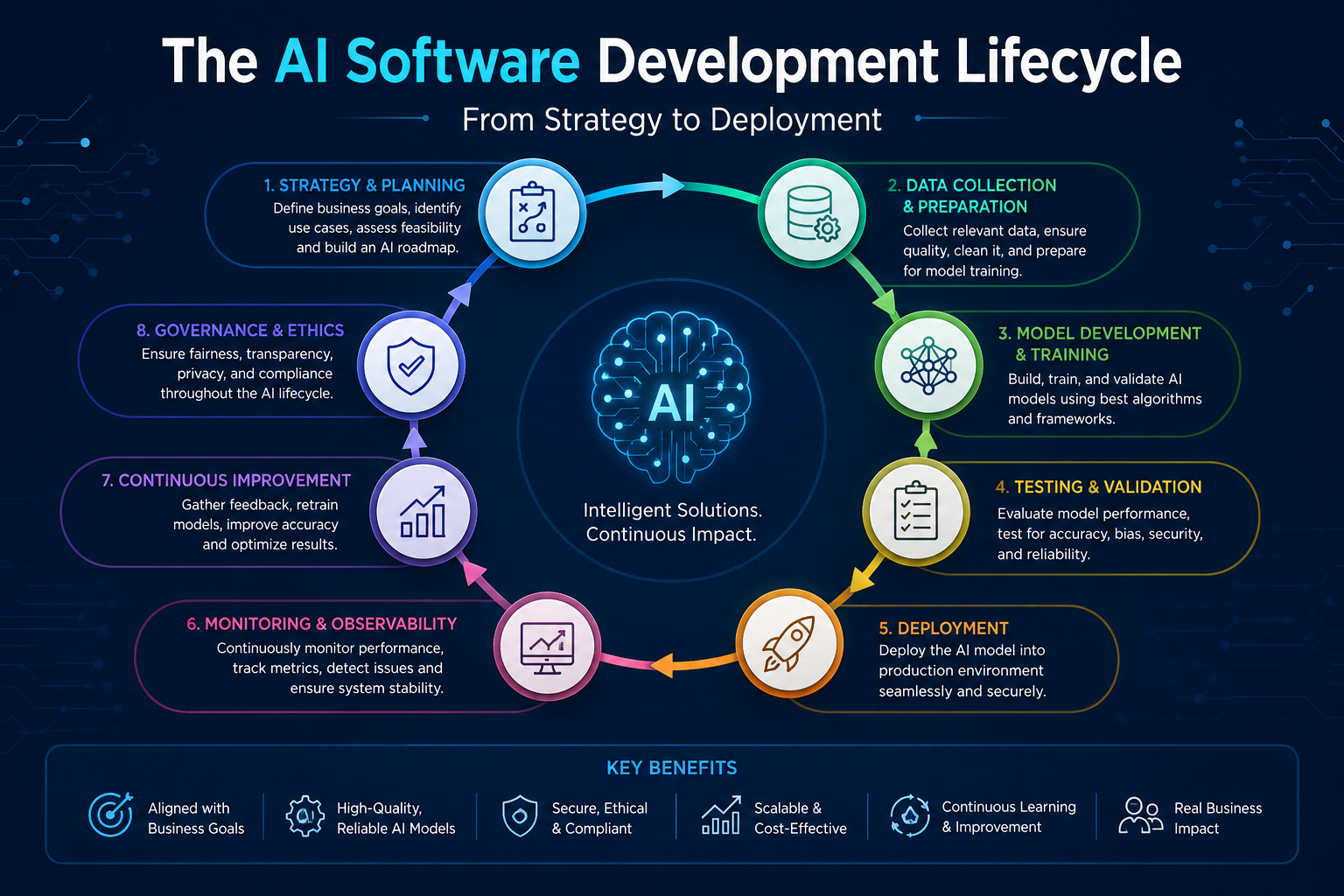
A successful AI project generally follows several stages.
Step 1 – Discovery and Feasibility Study
The first step is understanding the business problem. The development team identifies the objective, users, available data, expected outcomes, technical requirements, and potential risks.
A feasibility study then determines whether AI is actually the right solution.
Step 2 – Data Collection, Cleaning and Preparation
AI depends heavily on data quality. Relevant information must be collected, organised, cleaned, labelled where necessary, and prepared for model development.
Poor-quality or incomplete data can negatively affect the final system regardless of how sophisticated the model is.
Step 3 – Choosing the Right AI Model or Architecture
The technology should match the problem. Some applications require traditional machine learning, while others may benefit from deep learning, natural language processing, computer vision, or LLM-based architectures.
For generative AI applications, technologies such as retrieval-augmented generation can connect language models with business-specific information.
Step 4 – Prototype and Proof of Concept
Before investing heavily in development, teams often build a prototype or proof of concept (POC). This validates the technical approach and provides an early demonstration of how the system could work.
Step 5 – Model Training and Validation
Depending on the project, models may be trained, fine-tuned, configured, or integrated with existing AI services. Validation helps measure accuracy, reliability, latency, and other relevant performance indicators.
Step 6 – Integration With Existing Business Systems
AI becomes more useful when it works with existing business applications. Integration may involve CRM platforms, ERP systems, websites, mobile applications, databases, APIs, or internal tools.
Step 7 – Testing, Quality Assurance and Bias Auditing
Testing should cover functionality, security, performance, accuracy, edge cases, and usability. AI systems should also be checked for unexpected behaviour and potential bias.
Step 8 – Deployment
The application can be deployed using cloud, on-premise, or hybrid infrastructure depending on the business requirements.
Cloud platforms can provide scalability, while on-premise infrastructure may be preferred for certain highly sensitive workloads.
Step 9 – Monitoring, Retraining and Support
AI development does not necessarily end when the software goes live. Models and AI applications should be monitored for performance, data changes, security issues, and evolving business requirements.
Ongoing maintenance may include model updates, retraining, optimisation, bug fixes, and infrastructure improvements.
How Do You Choose the Right AI Development Partner in India?
Choosing the right custom AI development company requires more than comparing development prices.
Should You Choose an In-House Team, Freelancer or AI Agency?
An in-house team provides greater direct control but may require significant investment in recruitment and infrastructure. Freelancers can be cost-effective for smaller projects but may have limited resources for complex implementations.
An AI development agency can provide access to developers, AI engineers, designers, cloud specialists, and project management expertise under one engagement.
What Questions Should You Ask Before Hiring?
Ask about previous AI projects, technical expertise, data security practices, development methodology, technology stack, ownership of source code, testing procedures, and post-launch support.
You should also clarify how confidential business information will be handled and whether appropriate contractual protections such as an NDA are available.
What Are the Red Flags?
Be cautious about providers that promise unrealistic results, provide vague timelines, avoid discussing data security, cannot explain their technical approach, or offer no post-launch support.
How Long Does Custom AI Development Take?
The timeline depends on the project's complexity, data availability, integrations, model requirements, and testing needs.
How Long Does an MVP or POC Take?
A relatively focused AI proof of concept may take around 4–8 weeks, although actual timelines vary according to requirements.
How Long Does a Full Enterprise AI Solution Take?
A larger enterprise implementation may take approximately 3–9 months or longer when extensive integrations, security requirements, custom models, and multiple development phases are involved.
What Can Delay an AI Project?
Common causes include poor data quality, changing requirements, complex integrations, unavailable datasets, security reviews, infrastructure limitations, and insufficient testing.
What Data Privacy and Security Issues Should Indian Businesses Consider?
AI applications may process customer information, financial records, employee data, business documents, or other sensitive information. Security should therefore be considered during architecture and development rather than added at the end.
Does the DPDP Act 2023 Matter for AI Systems?
Yes. Businesses handling applicable digital personal data in India should consider the requirements of the Digital Personal Data Protection framework when designing AI systems.
Data collection, processing, consent or other lawful bases, security safeguards, retention, access controls, and responsibilities should be assessed according to the specific application.
What About RBI and SEBI Requirements?
AI applications used in financial services may need to account for applicable RBI, SEBI, cybersecurity, outsourcing, data governance, and risk-management requirements depending on the organisation and use case.
Should Businesses Consider Data Localisation?
Data residency and localisation requirements can vary by sector, contract, and regulatory framework. Before selecting cloud infrastructure, businesses should understand where their data is stored, processed, and transferred.
How Can AI Bias Be Reduced?
Use representative datasets, establish validation procedures, monitor outputs, document model behaviour, and maintain human oversight for high-impact decisions.
Is Custom AI Worth the Investment?
The answer depends on the expected business value.
When Are Off-the-Shelf AI Tools Enough?
Generic AI tools may be sufficient for content creation, basic customer support, summarisation, brainstorming, productivity, and other standard tasks.
When Is a Custom-Built AI Solution Better?
A custom solution can make sense when the business needs proprietary data integration, specialised workflows, advanced automation, deep system integration, greater control, or a competitive advantage that generic tools cannot provide.
How Can Indian SMEs Calculate AI ROI?
Businesses can compare the expected investment with measurable benefits such as reduced processing time, lower operational costs, increased conversions, fewer errors, faster customer response, and additional revenue.
For example:
AI ROI = (Financial Benefit − AI Investment) ÷ AI Investment × 100
The exact calculation should include development, infrastructure, maintenance, training, and operational costs.
What Technology Stack Is Used in AI Development?
The technology stack depends on the project.
Which AI Frameworks Are Commonly Used?
Popular technologies include TensorFlow, PyTorch, and LangChain, along with Python-based machine learning libraries, APIs, vector databases, data-processing frameworks, and model-serving technologies.
Which Cloud Platforms Can Be Used?
Businesses can use platforms such as AWS, Microsoft Azure, and Google Cloud. The AWS Mumbai region and other regional infrastructure options can be considered when location, latency, compliance, or data residency requirements are important.
Should Businesses Choose On-Premise or Hybrid Cloud?
Highly regulated or data-sensitive organisations may consider on-premise or hybrid architectures. The right choice depends on security, scalability, cost, compliance, and operational requirements.
What Do Real-World AI Projects Look Like?
Consider three hypothetical India-focused examples.
Case Study 1 – E-commerce AI
An Indian e-commerce business could implement an AI recommendation engine using product and customer interaction data. The objective could be to provide more relevant product suggestions and improve the shopping experience.
Case Study 2 – Fintech AI
A fintech startup could develop an AI-based system to identify unusual transaction patterns. The system could flag potentially suspicious activity for review while keeping human teams involved in important decisions.
Case Study 3 – Regional Language Chatbot
A business serving customers across India could develop a multilingual AI assistant capable of understanding regional languages. Such a system could improve accessibility and customer support for users who prefer communicating in their native language.
These examples demonstrate an important principle: AI should be designed around a measurable business problem rather than implemented simply because the technology is available.
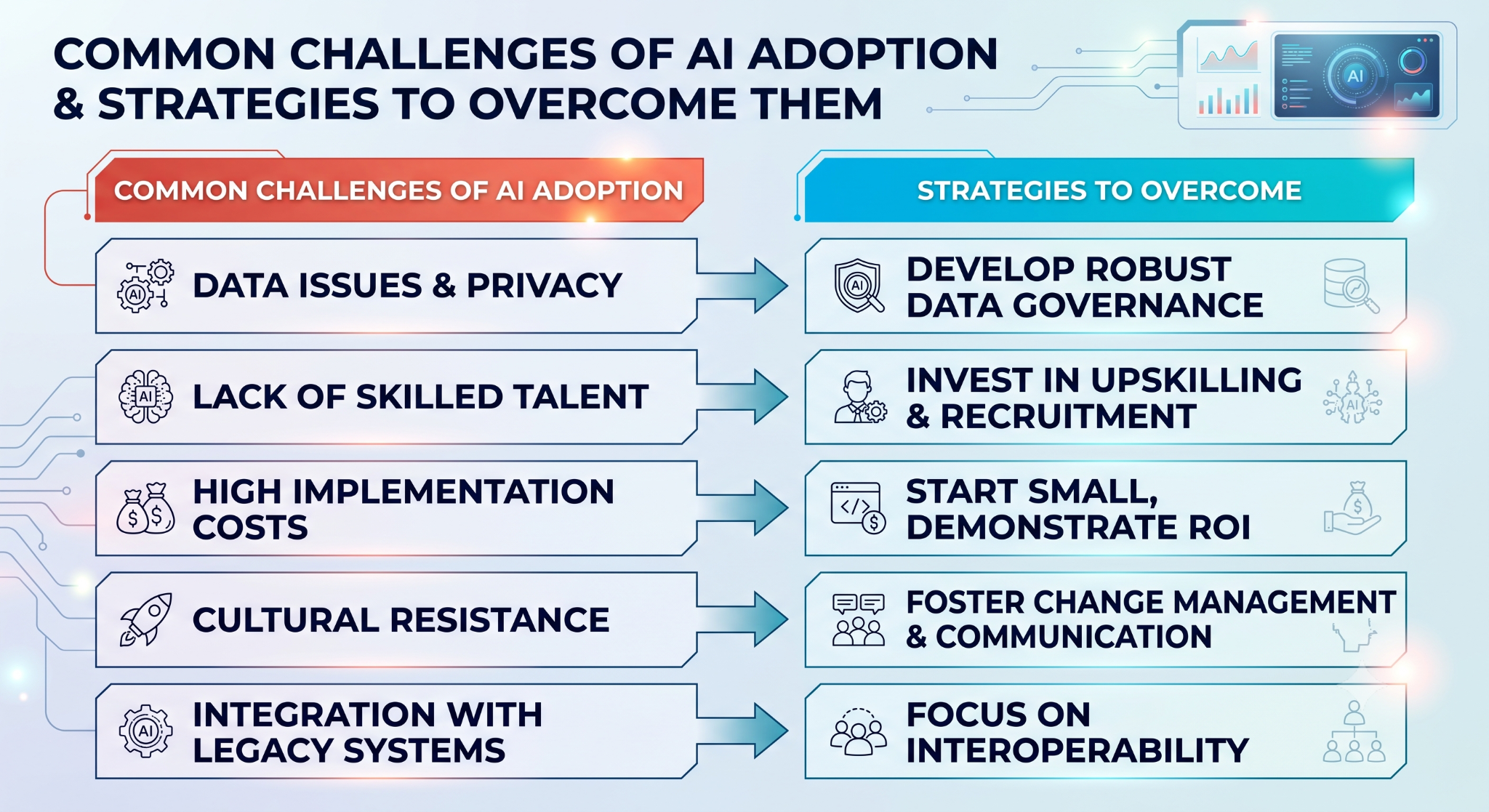
What Are the Common Challenges in Custom AI Development?
Is Poor Data Quality a Problem?
Yes. Inconsistent, outdated, incomplete, or incorrectly labelled data can significantly affect AI performance. Data preparation should therefore receive adequate attention.
What Happens If Business Objectives Are Unclear?
Without a clear objective, an AI project can become technically impressive but commercially ineffective. Every project should define measurable outcomes before development begins.
Can AI Systems Have Scalability Problems?
Yes. A prototype that works with a small dataset may require significant optimisation when thousands or millions of users interact with it. Architecture and infrastructure should therefore consider future scale.
Is AI Talent Difficult to Retain?
AI projects require multiple skills, including software development, machine learning, cloud infrastructure, data engineering, security, and product management. Working with an experienced custom AI development company can help businesses access these capabilities without building an entire specialised team internally.
Conclusion: How Can You Make the Right AI Investment Decision?
The best AI investment starts with a business problem, not a technology trend. Before development begins, define the objective, identify the available data, estimate the expected ROI, assess security and compliance requirements, and decide whether an off-the-shelf product or custom solution is appropriate.
What Should You Check Before Signing an AI Development Contract?
Use this checklist:
- Clearly defined business objectives
- Detailed project scope and deliverables
- Agreed development milestones
- Data privacy and security requirements
- NDA and confidentiality terms where appropriate
- Technology and infrastructure plan
- Testing and quality assurance process
- Ownership of source code and deliverables
- Deployment responsibilities
- Maintenance and post-launch support
- Performance metrics and success criteria
What Is the Next Step?
For businesses exploring AI adoption, the first step does not have to be a large-scale implementation. A discovery discussion can identify the most suitable use case, technical requirements, available data, expected investment, and potential business value.
Voicene Technologies LLP helps businesses explore AI development, custom software solutions, and digital transformation strategies from idea validation through development and deployment. If your organisation is considering an AI application, starting with a clearly defined use case and feasibility assessment can help turn an AI idea into a practical business solution.
Frequently Asked Questions About Custom AI Development
Recent Blogs