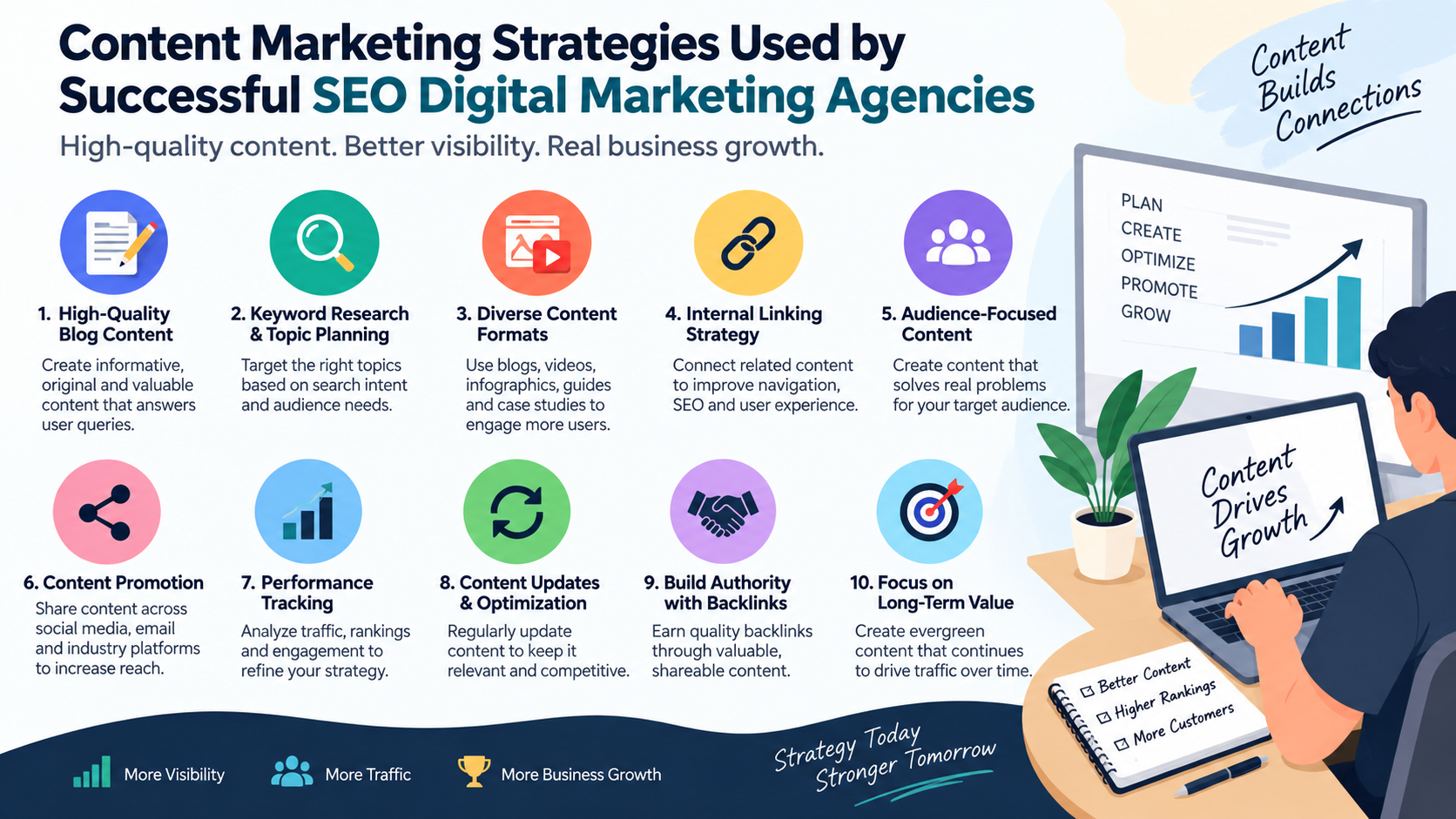
Content Marketing Strategies Used by Successful SEO Digital Marketing Agencies
What is content marketing and why is it important for SEO success in India?
Content marketing is one of the most effective ways for businesses to attract potential customers through useful, relevant, and trustworthy information. Instead of directly promoting a product or service in every piece of content, businesses answer the questions their target customers are already searching for.
For companies operating in India, this approach is particularly valuable because search behavior varies across industries, regions, languages, and customer segments. Successful seo digital marketing strategies therefore combine high-quality content with technical optimization, search intent analysis, local SEO, and consistent content distribution.
For example, an e-commerce company may publish buying guides, product comparisons, FAQs, and seasonal content before major shopping periods. A B2B software company may focus on technical guides, case studies, industry reports, and LinkedIn content.
The objective is simple: create content that helps users, earns trust, attracts search visibility, and ultimately generates qualified leads or sales.
How is the Indian digital consumer different from other markets?
India has a highly diverse digital audience. Users search in English as well as regional languages such as Hindi, Tamil, Telugu, Bengali, Malayalam, and others.
Mobile browsing is also extremely important. Businesses targeting Indian customers should therefore ensure that their content is easy to read on smaller screens and loads efficiently, particularly for users on mobile networks.
Search intent can also be strongly influenced by price, location, convenience, reviews, and seasonal offers. During festivals, wedding seasons, major shopping events, and national holidays, search behavior can change significantly.
Successful SEO agencies study these patterns before developing their content strategy.
What content marketing strategies do successful SEO agencies use?
1. Keyword research based on search intent
Effective keyword research goes beyond finding keywords with high search volume. Agencies identify what the user actually wants when searching.
For example:
- Informational intent: “What is SEO?”
- Commercial intent: “Best SEO agency in India”
- Transactional intent: “SEO services pricing”
- Local intent: “SEO agency in Bangalore”
The content should match the intent behind the query. A user searching for information should receive an educational resource, while someone ready to purchase may need a service page, comparison, pricing information, or case study.
2. Topic clusters and pillar pages
Instead of publishing unrelated blog posts, successful agencies build topic clusters.
A detailed pillar page covers the main subject, while supporting articles answer related questions. Internal links connect these resources and help users navigate between related topics.
For example, an e-commerce website could create a main guide about e-commerce SEO and support it with articles about product-page optimization, technical SEO, category pages, image optimization, and conversion optimization.
This approach can help establish topical relevance while creating a better user experience.
3. E-E-A-T focused content
Trust is increasingly important for websites competing in organic search.
Content should demonstrate experience, expertise, authority, and trust. Businesses can strengthen these signals by including author information, company details, genuine examples, original insights, customer experiences, case studies, and accurate references.
Rather than producing generic articles, businesses should explain what they actually know and how their services solve real customer problems.
4. Long-form guides and quick answers
Long-form content can provide comprehensive information, but users also want quick answers.
A strong page can combine both approaches. Start sections with concise answers and then provide deeper explanations for readers who want more information.
This Q&A structure is particularly useful for Answer Engine Optimization because questions can be clearly identified and answered within the page.
How does on-page SEO support content marketing?
Content quality alone is not enough. Search engines need to understand the structure and subject of a page.
Important on-page elements include:
- SEO-friendly title
- Clear H1 and H2 headings
- Descriptive URLs
- Relevant meta descriptions
- Proper image alt text
- Internal links
- Helpful external references
- Structured data where appropriate
- Clear introduction
- Well-organized paragraphs
- Relevant keyword variations
The primary keyword should appear naturally in important locations without forcing it into every paragraph.
The goal should always be useful content first and optimization second.
Why is technical SEO important for content performance?
Technical SEO provides the foundation on which content performance depends.
A page should be accessible to search engines, mobile-friendly, fast enough for users, and properly structured.
Core Web Vitals and page loading performance are especially important for mobile visitors. Large images, unnecessary scripts, poor hosting configurations, and inefficient page structures can negatively affect the user experience.
Successful agencies therefore combine content work with technical SEO rather than treating them as completely separate activities.
How can local SEO help Indian businesses?
Local SEO is essential for businesses that serve specific cities or regions.
A business can create useful location-focused pages that answer local customer needs. For example, a company serving Bangalore could create a page focused on its services in Bangalore rather than simply adding the city name repeatedly to a generic page.
Google Business Profile optimization, genuine customer reviews, local references, and relevant local links can further strengthen local visibility.
However, city pages should provide genuinely useful local information. Creating many nearly identical pages with only the location name changed can create a poor user experience.
What role does e-commerce SEO play in content marketing?
E commerce seo service strategies require more than optimizing product descriptions.
E-commerce websites can use content to support customers throughout the buying journey.
Useful content formats include:
- Product comparison guides
- Buying guides
- Product FAQs
- Category guides
- How-to articles
- Reviews
- Seasonal shopping guides
- Product-use tutorials
- Troubleshooting content
For example, a website selling home appliances could publish a guide explaining how to choose an energy-efficient appliance, followed by product comparisons and links to relevant categories.
This connects informational content with commercial pages and creates opportunities to move users from research to purchase.
How can agencies use social media to distribute SEO content?
Publishing an article is only the beginning.
A single high-quality article can be repurposed into a LinkedIn post, carousel, short video, infographic, email newsletter, or social media discussion.
For B2B companies, LinkedIn can be useful for sharing expertise and building professional credibility. For B2C and D2C businesses, Instagram, YouTube Shorts, and other visual formats can expand content reach.
WhatsApp communities and business communication can also help businesses distribute useful resources to existing customers.
The important point is that social distribution should support the overall content strategy rather than simply copying the same message everywhere.
How does content marketing help build backlinks?
Good content can naturally attract references from other websites.
Successful agencies may create original research, industry reports, statistics, detailed guides, tools, comparison resources, or expert commentary that other websites find useful.
Digital PR can also be used to present interesting business data or industry insights to relevant media publications.
Instead of focusing only on guest posting, businesses should think about creating assets that are genuinely worth referencing.
How should a business evaluate an SEO digital marketing agency?
Before hiring an agency, businesses should examine its actual capabilities rather than relying only on ranking promises.
Ask the agency:
- Can you show relevant case studies?
- How do you measure organic traffic?
- How do you measure qualified leads and conversions?
- Who owns the content after the project ends?
- How do you conduct keyword research?
- How do you handle technical SEO?
- How do you report performance?
- How do you update older content?
- Do you have a localization strategy?
- How do you avoid keyword stuffing?
A good agency should be able to explain its strategy clearly and connect SEO activities to business objectives.
How much do content marketing services cost in India?
Pricing varies depending on the business size, competition, content volume, technical requirements, industry, and level of expertise required.
Startups may need a focused strategy built around a small number of high-value topics. SMEs may require ongoing blog production, landing pages, technical SEO, link building, and local optimization. Enterprises often require larger-scale content operations, multiple locations, languages, and detailed reporting.
Additional services such as professional design, video production, translation, original research, and digital PR may increase the overall investment.
Instead of choosing an agency solely by price, businesses should compare the scope of work, quality, expertise, reporting, and expected business outcomes.
Which industries benefit most from content-led SEO?
Almost any industry can benefit from useful organic content, but some sectors have particularly strong opportunities.
These include:
- E-commerce and D2C
- EdTech
- Healthcare and wellness
- Real estate
- Fintech
- Software and technology
- Professional services
- Local businesses
The best strategy depends on the customer's questions, buying journey, competition, and search behavior.
What are the most common content SEO mistakes?
One of the biggest mistakes is writing content purely for search engines.
Keyword stuffing can make content unnatural and reduce its usefulness. Another common problem is publishing large quantities of generic content without demonstrating real expertise.
Businesses may also ignore regional search opportunities, fail to update older pages, overlook internal linking, or focus on rankings without measuring leads and revenue.
A successful search engine optimization strategy should ultimately connect visibility with meaningful business results.
Conclusion: What makes a successful content-led SEO strategy?
Successful seo digital marketing is not simply about inserting keywords into articles. It combines search intent, valuable content, technical SEO, internal linking, local optimization, trust signals, and consistent distribution.
Businesses should focus on answering real customer questions, demonstrating genuine expertise, and creating useful resources that remain valuable beyond a single search query.
For e-commerce businesses, an effective e commerce seo service strategy can connect informational content with product and category pages. For local businesses, localized content and Google Business Profile optimization can strengthen discovery. For B2B companies, case studies, guides, reports, and thought leadership can support both organic visibility and lead generation.
The strongest approach is therefore a balanced one: create content for people, optimize it for search engines, structure it for answer engines, and measure its contribution to real business goals.
Frequently Asked Questions
Recent Blogs