Top Benefits of AI-Powered Intelligent Data Analytics
Businesses generate more data than ever, but collecting information is only the first step. The real advantage comes from understanding that data and turning it into useful business decisions. AI-powered intelligent data analytics combines artificial intelligence, machine learning, automation, and data analysis to help organizations identify patterns, predict trends, and make faster decisions.
For businesses in India, this approach can be particularly useful as companies manage growing customer information, sales data, operational records, financial transactions, and digital interactions. Instead of relying only on historical reports, organizations can use intelligent analytics to understand what is happening, why it is happening, and what may happen next.
What Is AI-Powered Intelligent Data Analytics?
AI-powered intelligent data analytics is the use of artificial intelligence and advanced analytical technologies to collect, process, interpret, and act on business data.
Traditional analytics generally focuses on reporting historical information. For example, a dashboard may show last month's sales, website traffic, or customer conversions. AI-powered analytics can go further by identifying patterns, detecting unusual activity, forecasting future outcomes, and supporting business recommendations.
A modern analytics solution can combine data from sources such as:
- CRM and customer databases
- Sales and marketing platforms
- Financial systems
- E-commerce applications
- Websites and mobile applications
- Operational and supply-chain systems
- Customer support platforms
This creates a more connected view of business performance.
What Are the Top Benefits of AI-Powered Data Analytics?
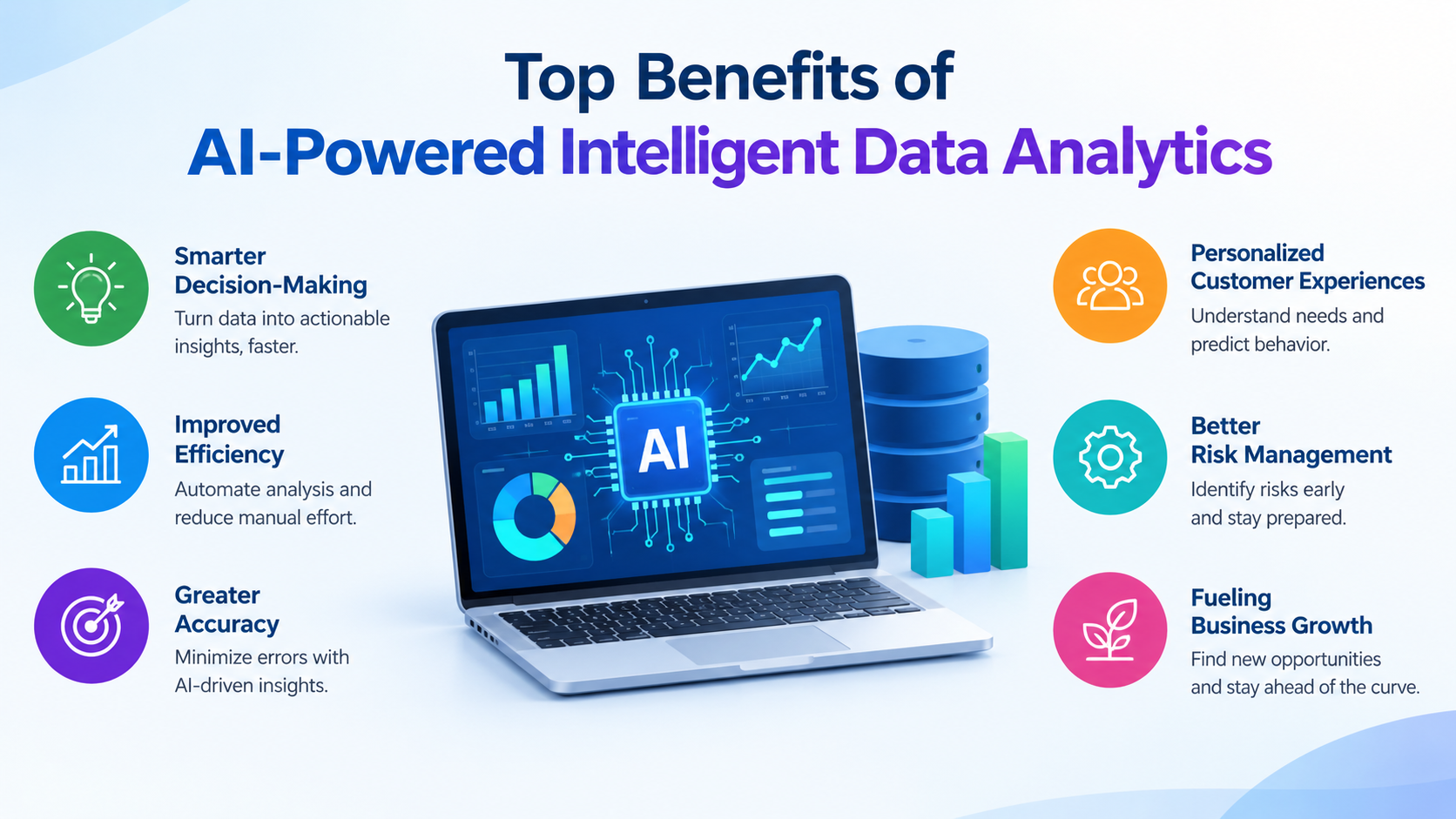
The main benefits include faster decision-making, predictive insights, improved operational efficiency, better customer understanding, and stronger data-driven planning.
1. Faster Business Decision-Making
One of the biggest advantages of intelligent data analytics is the ability to process large volumes of information quickly.
Instead of manually reviewing spreadsheets and reports, decision-makers can access summarized insights and identify important changes more efficiently. AI can help highlight trends, anomalies, and relationships that may not be immediately visible in conventional reports.
This allows management teams to spend less time collecting information and more time deciding what actions to take.
2. Predictive Insights for Better Planning
Historical data can explain what happened, but predictive analytics can help businesses prepare for what may happen next.
AI models can analyze previous patterns and current information to identify potential trends. Depending on the business and available data, organizations can use predictive analytics for demand forecasting, customer behavior analysis, sales planning, inventory management, and risk monitoring.
These predictions should support, not replace, human decision-making, particularly when business conditions change quickly.
3. Improved Operational Efficiency
AI can identify repetitive processes, performance gaps, and unusual patterns across business operations.
For example, an organization may discover that certain processes consistently create delays or that specific operational activities consume more resources than expected.
By identifying these patterns, businesses can investigate the underlying causes and improve workflows. Analytics can therefore support automation and process optimization while giving teams clearer visibility into performance.
4. Better Customer Understanding
Customer data can provide valuable information about preferences, purchasing behavior, engagement, and support requirements.
Intelligent data analytics can bring these signals together to create more useful customer insights. Businesses can use this information to identify customer segments, understand purchasing patterns, analyze campaign performance, and improve customer experiences.
When combined with technologies such as AI chatbots and virtual assistance, analytics can also help organizations understand common customer questions and support interactions.
5. More Accurate Performance Monitoring
Businesses need reliable performance information to understand whether their strategies are working.
AI-powered analytics can bring important metrics into centralized dashboards and reports. Instead of checking multiple systems independently, teams can monitor relevant information from a more connected environment.
Useful metrics may include:
- Revenue and sales performance
- Customer acquisition
- Conversion rates
- Marketing performance
- Operational costs
- Customer retention
- Support performance
The exact metrics should be selected according to the organization's objectives rather than simply tracking every available data point.
How Can AI Integration Cloud Solutions Support Data Analytics?
Cloud infrastructure makes it easier for businesses to store, process, and access data across different systems.
AI integration cloud solutions can connect analytical applications with business platforms, databases, APIs, and other digital services. This can help organizations create scalable data workflows without relying entirely on isolated systems.
Cloud-based analytics can also support collaboration because authorized teams can access relevant information from different locations. However, businesses should carefully evaluate access controls, encryption, data governance, compliance requirements, and vendor security before implementing a cloud analytics platform.
What Are the Industry-Specific Benefits in the Indian Market?
Different industries use data in different ways, so the value of AI analytics depends on the organization's objectives and available information.
Banking and Financial Services
Financial organizations can analyze transaction patterns, customer behavior, operational performance, and potential risk indicators. Analytics can support fraud monitoring, customer segmentation, forecasting, and business reporting.
Retail and E-Commerce
Retail businesses can analyze purchasing behavior, product performance, inventory trends, and customer interactions. These insights can support demand planning and more relevant marketing strategies.
Manufacturing
Manufacturers can use analytics to monitor production data, identify operational patterns, forecast demand, and investigate potential inefficiencies.
Healthcare
Healthcare organizations can analyze operational and administrative data to improve planning and resource utilization. Because healthcare information can be highly sensitive, organizations need appropriate privacy, security, and governance measures.
What Is the Business Case and ROI for Indian Companies?
The return on investment from AI analytics depends on factors such as data quality, implementation cost, business objectives, adoption, and the specific use case.
A company should not adopt analytics simply because AI is popular. Instead, it should begin with a measurable business problem.
For example, an organization may want to:
- Reduce reporting time
- Improve sales forecasting
- Reduce operational waste
- Identify customer churn risks
- Improve marketing performance
- Detect unusual transactions
- Increase productivity
Defining a measurable baseline before implementation makes it easier to evaluate whether the analytics solution is producing meaningful business value.
How Should a Business Choose the Right AI Data Analytics Platform?
There is no single analytics platform suitable for every organization.
Before choosing a solution, businesses should evaluate:
- Data integration: Can the platform connect with existing systems?
- Scalability: Can it handle increasing data volumes?
- Security: What controls protect business and customer information?
- Ease of use: Can business teams understand and use the insights?
- AI capabilities: Does it provide useful forecasting, anomaly detection, or automation features?
- Customization: Can the solution support industry-specific requirements?
- Cost: Does the pricing model match the expected business value?
- Support: Is technical assistance available when required?
The best implementation is usually one that solves a clearly defined business problem while fitting the organization's existing technology environment.
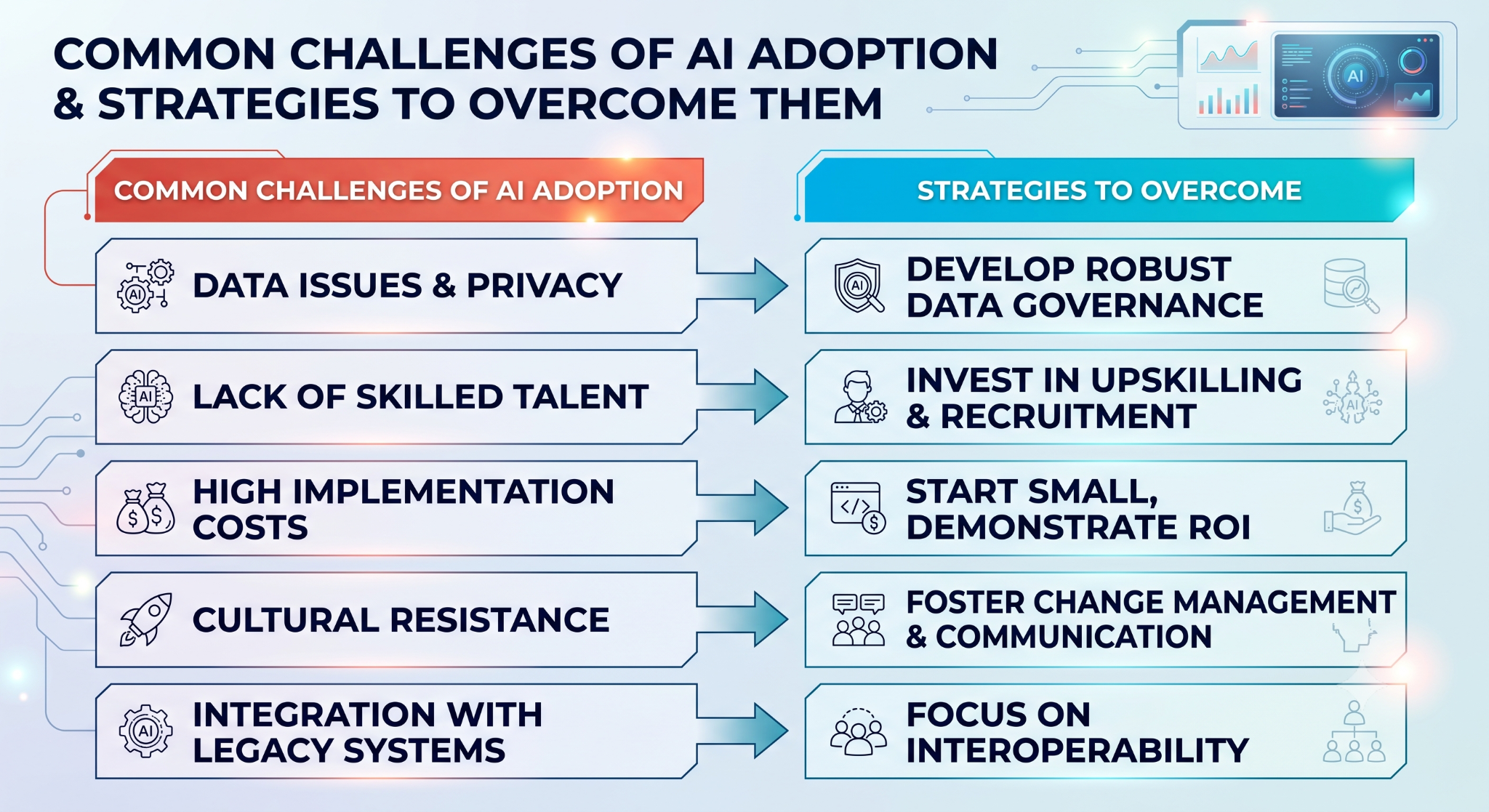
What Are the Common Challenges of AI Data Analytics?
AI analytics can provide significant value, but implementation also comes with challenges.
Poor-quality data can produce unreliable insights. Disconnected systems can make integration difficult. Employees may also need training to understand and use analytical outputs correctly.
Other considerations include data privacy, cybersecurity, governance, infrastructure costs, and model reliability.
Businesses can reduce these challenges by starting with a focused use case, cleaning and organizing important datasets, defining access controls, and continuously reviewing analytical results.
What Is a Practical Implementation Roadmap?
A structured implementation process can make AI analytics easier to manage.
Step 1: Define the Business Objective
Identify the problem the organization wants to solve.
Step 2: Identify Relevant Data
Determine which internal and external datasets are required.
Step 3: Prepare the Data
Clean, organize, validate, and integrate the relevant information.
Step 4: Select the Technology
Choose analytics, AI, cloud, and integration technologies based on the business requirement.
Step 5: Start With a Pilot
Test the solution on a focused use case before expanding it across the organization.
Step 6: Measure Results
Track measurable outcomes and compare them with the original baseline.
Step 7: Scale Gradually
Once the system demonstrates value, expand it to additional departments, datasets, or processes.
What Is the Future of AI-Powered Data Analytics in India?
The future of business analytics is moving toward more automated, connected, and accessible decision-support systems.
Organizations are increasingly combining analytics with AI automation, cloud infrastructure, conversational interfaces, and intelligent business applications. Instead of requiring users to manually search through multiple dashboards, future systems can make important information easier to access through natural-language interactions.
AI-powered analytics may also become more closely connected with automated workflows. For example, an analytical system could identify an unusual business pattern and trigger a predefined workflow for human review.
However, responsible implementation will remain important. Data quality, privacy, security, transparency, human oversight, and governance should remain central to any AI analytics strategy.
Conclusion
AI-powered intelligent data analytics can help businesses transform large volumes of information into practical insights. From faster decision-making and predictive planning to customer understanding and operational improvement, the technology can support organizations across multiple industries.
The most effective approach is not to use AI simply for the sake of adopting new technology. Businesses should identify specific challenges, connect the right data sources, select suitable technologies, and measure business outcomes throughout implementation.
For organizations looking to combine analytics with broader digital transformation, solutions involving AI development, cloud integration, automation, and intelligent business applications can provide a foundation for building more connected data-driven operations.
FAQs
It can be, depending on the business requirement, data volume, platform, and implementation model. Businesses can begin with a focused use case rather than implementing an organization-wide system immediately.
Recent Blogs