Custom AI Software Development for Business Process Automation
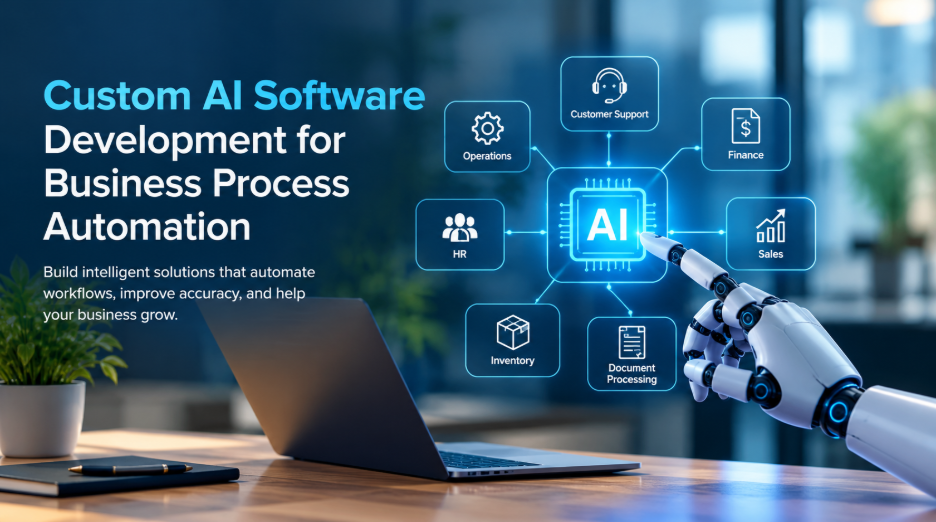
How can businesses reduce repetitive tasks, improve productivity, and manage daily operations more efficiently? Custom AI software development offers a practical way to automate business processes according to an organisation's specific needs. From customer support and financial reporting to inventory management and employee onboarding, artificial intelligence can help businesses simplify workflows and make better use of their resources.
Indian businesses are increasingly exploring intelligent automation to manage growing workloads without unnecessarily complicating their operations. Unlike generic automation tools, custom solutions can be designed around existing processes, software systems, and business objectives. With suitable AI software development services, organisations can build applications that combine machine learning, natural language processing, intelligent document processing, and workflow automation.
The key is to identify the right processes for automation, prepare reliable data, and introduce AI with appropriate human supervision. This guide explains how businesses can evaluate, implement, and benefit from AI-powered process automation.
What Is Custom AI Software Development for Business Process Automation?
Custom AI software development involves creating software that uses artificial intelligence to automate or support specific business activities. Instead of following only predefined instructions, an AI-powered system can analyse information, recognise patterns, classify documents, and generate recommendations based on its capabilities and available data.
For example, a business receiving hundreds of invoices may use AI to extract supplier details, invoice numbers, tax information, and payment totals. The software can then transfer verified information into an accounting system, reducing the need for manual data entry.
How Does AI Automate Business Workflows?
AI automation combines intelligent processing with business rules and software integrations. A typical workflow may include:
- Collecting information from emails, documents, forms, or business applications.
- Analysing and classifying incoming data using suitable AI models.
- Applying predefined rules to determine the next action.
- Sending information to connected systems.
- Requesting human approval when the system encounters uncertainty or a sensitive decision.
- Recording results for reporting and future improvements.
The exact workflow depends on the business requirements and the reliability of the underlying technology.
What Is the Difference Between Traditional Automation, RPA, and AI Automation?
Traditional automation follows predefined rules for predictable tasks. Robotic process automation (RPA) uses software bots to perform structured, repetitive actions, such as copying information between applications.
AI-powered automation can handle additional tasks involving unstructured text, document recognition, classification, and language processing. Businesses may combine RPA and AI when a workflow requires both intelligent analysis and rule-based execution.
Which Business Processes Can AI Software Automate?
AI can support many departments, but the most appropriate applications depend on the complexity of the workflow, available data, and potential business value.
Can AI Automate Customer Support?
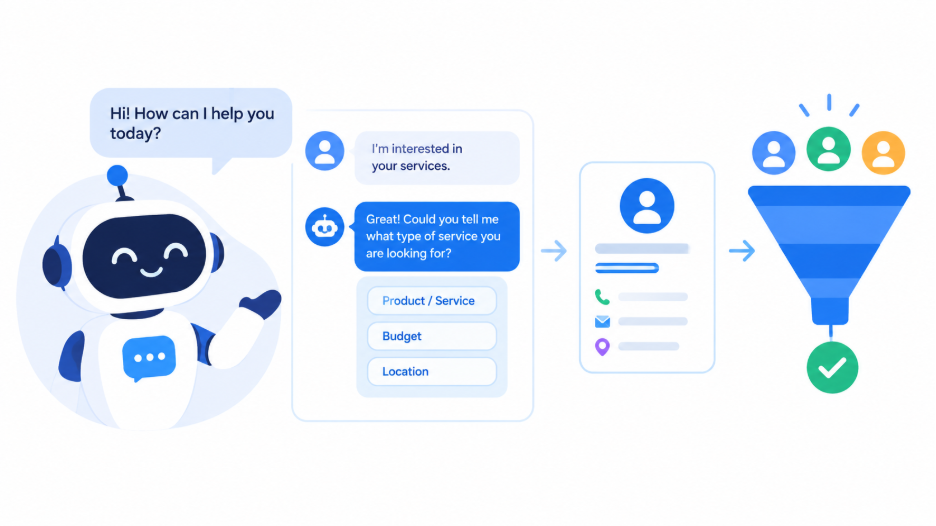
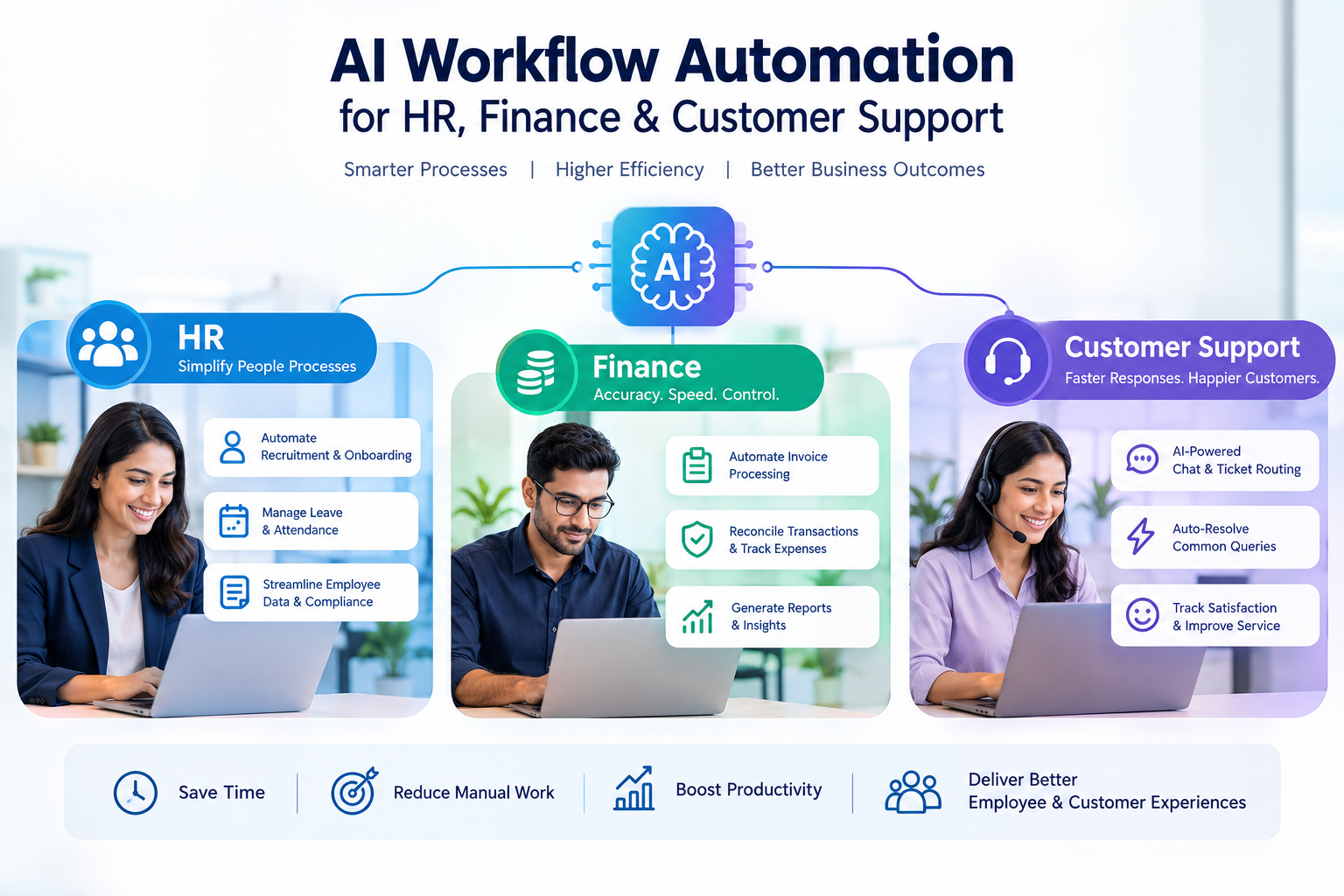
Yes. AI chatbots and virtual assistants can answer frequently asked questions, provide order updates, guide customers through basic troubleshooting, and route complex enquiries to the appropriate team.
For Indian businesses serving customers in multiple regions, language-processing capabilities may help manage enquiries in English and supported regional languages. Human representatives should remain available for complaints, unusual requests, and situations requiring judgement.
Can AI Automate Invoice Processing and Financial Reporting?
AI-powered document processing can extract information from invoices, receipts, purchase orders, and other financial documents. For example, a company may use optical character recognition (OCR) and AI to capture GST invoice details and prepare records for accounting software.
The system can flag missing fields, duplicate invoices, and discrepancies for review. Financial approvals, tax treatment, and payments should follow the organisation's established controls.
How Can AI Improve HR Operations?
AI can assist with recruitment administration, employee onboarding, document classification, attendance reporting, and responses to common HR questions.
For instance, an onboarding workflow could collect employee documents, check whether required forms have been submitted, and notify the HR team about outstanding tasks. Decisions involving hiring, employee evaluation, or sensitive personal information require appropriate oversight.
Can AI Support Sales and Inventory Management?
Sales teams can use AI to classify leads, summarise customer interactions, prepare follow-up reminders, and identify potential sales opportunities. Inventory teams can use historical sales and operational data to support demand forecasting and stock planning.
These systems can help employees prioritise their work, but their recommendations should be reviewed against changing market conditions and actual business requirements.
How Does AI Simplify Document Processing and Data Entry?
AI can process information from PDFs, scanned documents, email attachments, and digital forms. After extraction, the information can be validated and transferred to connected business systems.
This is particularly useful for organisations handling large document volumes. However, scanned images, inconsistent layouts, and poor-quality data can affect accuracy, making validation and exception handling important parts of the workflow.
What Are the Main Benefits of Custom AI Automation?
Does AI Reduce Manual Work?
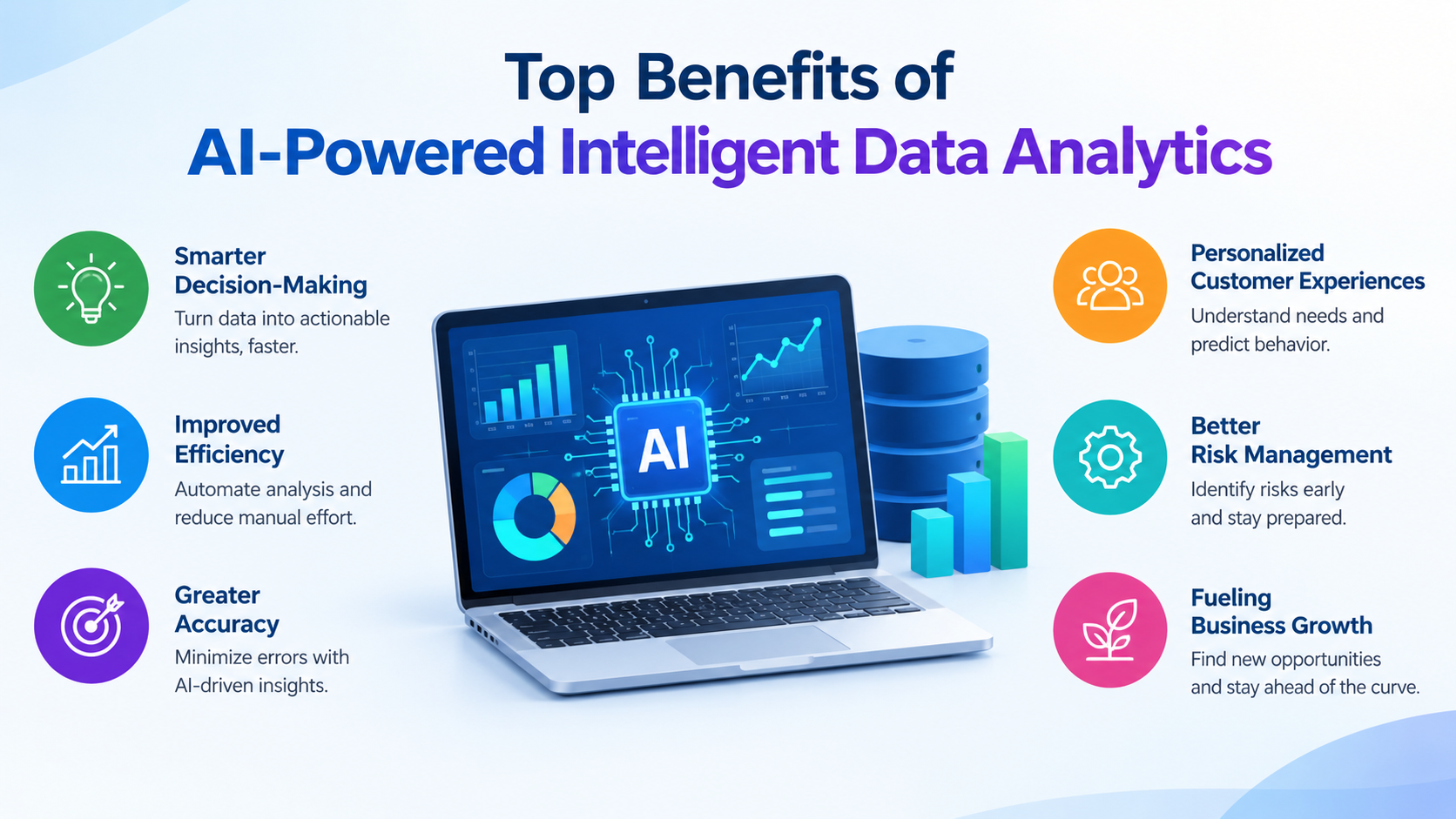
AI can reduce the amount of repetitive work employees perform, particularly when tasks involve predictable document processing, information retrieval, or routine customer enquiries. Employees can then focus more on activities that require communication, problem-solving, and decision-making.
Can AI Improve Accuracy?
AI systems can help standardise data processing and identify inconsistencies. However, accuracy is not automatic. Incorrect source data, unfamiliar document formats, and unreliable model outputs can still produce errors.
Businesses should measure extraction accuracy, exception rates, processing time, and the amount of human correction required.
Can AI Help Businesses Scale?
Automating suitable workflows can help an organisation manage increased transaction volumes without increasing manual effort at the same rate. Actual capacity depends on software performance, infrastructure, integration limits, and the need for human review.
How Does AI Support Better Business Decisions?
AI can analyse operational data and present summaries, patterns, and forecasts. Managers can use these insights alongside employee experience and other relevant evidence when making decisions.
Custom AI Software vs Ready-Made Automation Tools: Which Is Better?
The right choice depends on whether an organisation needs standard functionality or a solution built around specialised workflows.
| Comparison factor | Ready-made tools | Custom AI software |
|---|---|---|
| Initial investment | Usually lower | Often higher |
| Implementation | Often faster | Depends on project scope |
| Customisation | Limited to available features | Designed around specific needs |
| Integration | Uses supported connectors and APIs | Can be developed for required systems |
| Maintenance | Often managed by the vendor | Depends on the development agreement |
| Best suited for | Standard business processes | Complex or specialised workflows |
When Should a Business Choose Ready-Made Tools?
Ready-made tools are often suitable when a business needs common features, wants to implement a solution quickly, and can work within the available functionality.
When Is Custom AI Development More Suitable?
Custom development may be appropriate when a business has specialised workflows, several interconnected systems, unique data requirements, or automation needs that existing tools cannot adequately support.
Before investing, businesses should compare the total ownership cost, security requirements, integration complexity, and long-term flexibility of each option.
How Much Does Custom AI Software Development Cost in India?
There is no single price for every AI automation project. The investment depends on the problem being solved, the technologies involved, and the scope of implementation.
What Factors Influence Development Costs?
Important factors include:
- Number and complexity of workflows.
- AI model selection and third-party API usage.
- Integration with ERP, CRM, accounting, and legacy systems.
- Data preparation, migration, and quality assessment.
- Security controls, testing, and deployment requirements.
- Hosting, technical support, and ongoing model maintenance.
A basic proof of concept may require fewer resources than a complete business application connected to several departments.
Should Businesses Start With a Proof of Concept or a Full Solution?
A proof of concept tests whether an AI approach is technically feasible. A minimum viable product (MVP) provides a limited but usable version of the solution. A full-scale implementation introduces the functionality, integrations, and controls required for wider operational use.
Starting with a small, clearly defined workflow can help businesses evaluate performance before committing to a larger project.
How Can Businesses Estimate Return on Investment?
Businesses can compare the current workflow with the proposed automated process by measuring staff time, processing volume, error rates, turnaround time, and ongoing software expenses.
The evaluation should include development, integration, maintenance, and human-review costs. Potential savings should be treated as estimates until actual operational results are available.
What Features Should Custom AI Automation Software Include?
The right feature set should support business objectives rather than add unnecessary complexity.
Which Integrations Are Essential?
The software may need to connect with accounting platforms, customer relationship management systems, enterprise resource planning software, email applications, or internal databases.
Integration requirements should be identified early to avoid unexpected development work.
Why Are Security and Access Controls Important?
Business automation systems may process confidential documents, customer details, and financial records. Role-based access, encryption, secure authentication, appropriate data retention, and activity logging can help protect this information.
Businesses should also review applicable privacy obligations and the security practices of any third-party AI providers.
Should AI Decisions Require Human Approval?
Human review is important for sensitive financial transactions, unusual exceptions, legal matters, and other high-impact decisions. A well-designed system should identify situations where confidence is insufficient or where business rules require approval.
Does the Software Need Reporting and Analytics?
Dashboards can help teams monitor processing volumes, workflow completion, errors, exceptions, and performance over time. These measurements provide a practical basis for improving the system after deployment.
How Can Businesses Choose the Right AI Software Development Company in India?
Selecting a development partner requires more than comparing proposals. Businesses should assess technical expertise, communication, security practices, and the ability to understand operational requirements.
What Experience Should a Development Company Have?
Review relevant project examples, industry knowledge, and experience with AI models, APIs, cloud platforms, data engineering, and software integration. Ask providers to explain how they would approach your specific workflow rather than relying only on general claims.
What Questions Should You Ask Before Signing a Contract?
Consider asking:
- Have you developed similar automation solutions?
- Can the software integrate with our existing applications?
- How will accuracy and business impact be measured?
- Who owns the source code and custom-developed components?
- What support, maintenance, and monitoring are included?
- How will confidential business data be handled?
The agreement should clarify deliverables, timelines, acceptance criteria, ownership, support responsibilities, and any recurring third-party costs.
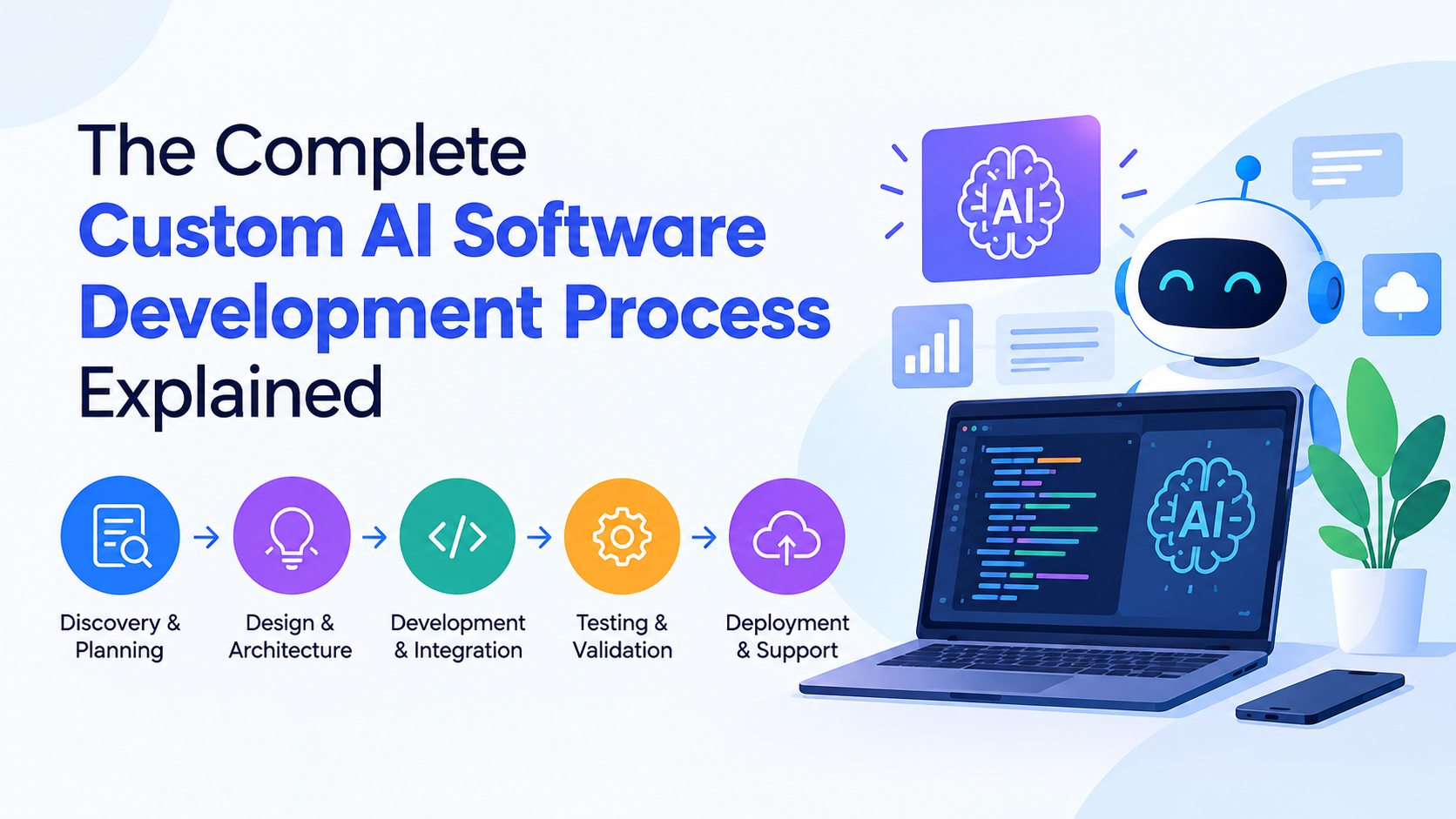
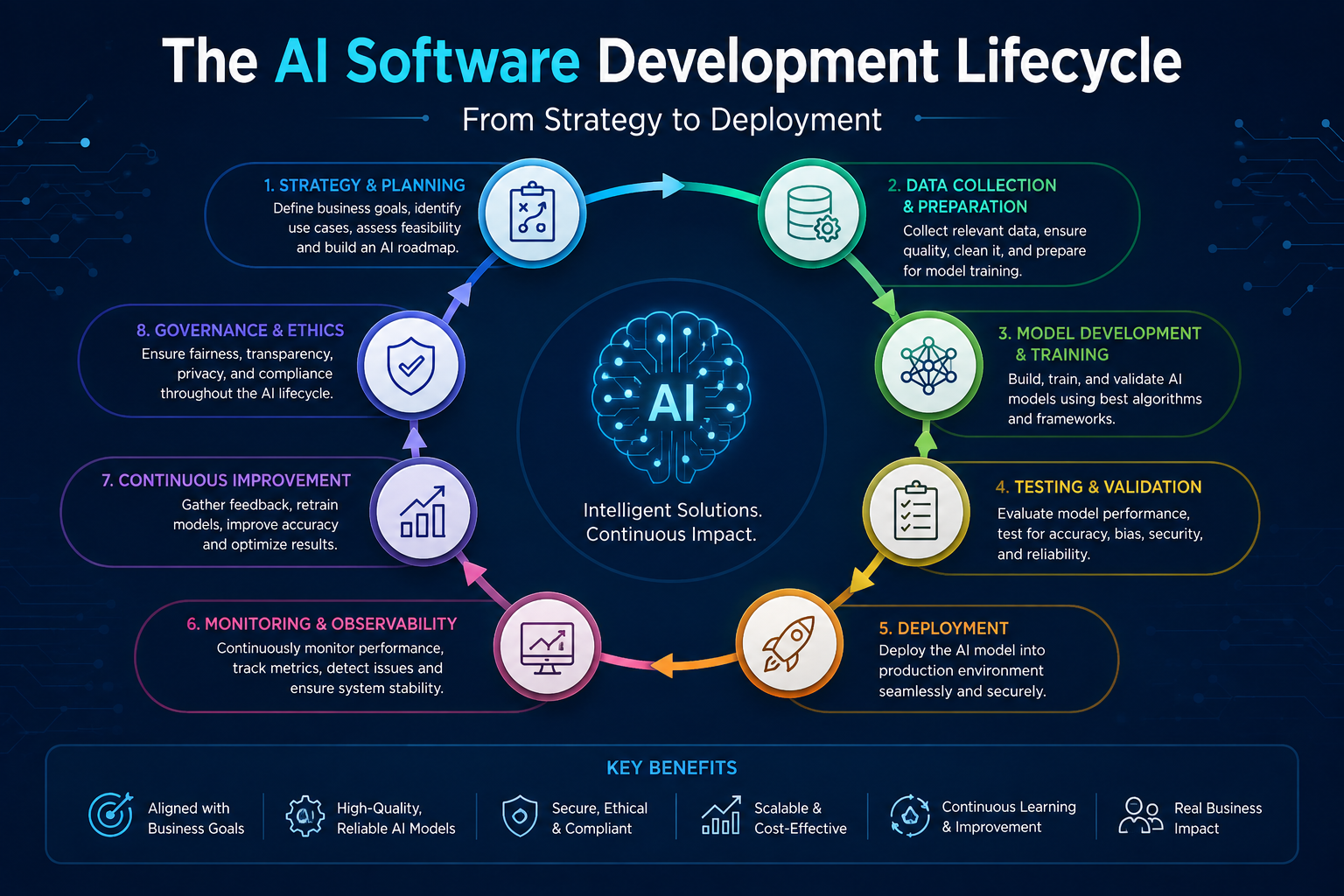
What Is the Process for Implementing Custom AI Automation?
A structured implementation process helps businesses reduce uncertainty and validate whether the proposed solution meets their needs.
Step 1: Identify Repetitive Tasks
Map the current workflow and identify bottlenecks, unnecessary manual steps, recurring errors, and tasks that consume significant employee time.
Step 2: Assess Data and Technical Requirements
Determine where the required data is stored, whether it is reliable, and which applications need to communicate with the new system.
Step 3: Test the Approach
Build a proof of concept using representative data. Evaluate whether the AI can perform the intended task accurately enough for the business use case.
Step 4: Develop and Integrate the Solution
Create the application, configure business rules, connect required systems, and establish approval and exception-handling processes.
Step 5: Test Performance and Security
Test normal scenarios, unusual inputs, integration failures, access permissions, and the accuracy of AI-generated outputs before deployment.
Step 6: Deploy and Monitor
Train employees, introduce the solution gradually, and track operational performance. Regular monitoring helps identify errors, changing requirements, and opportunities for improvement.
Which Industries in India Can Benefit From AI Business Automation?
Several industries can apply AI to specific operational challenges.
- IT services and BPO: Automating ticket classification, knowledge retrieval, and routine support workflows.
- Healthcare administration: Assisting with appointment enquiries, document processing, and administrative records while protecting sensitive information.
- E-commerce and retail: Supporting order-status enquiries, product categorisation, and inventory planning.
- Manufacturing and logistics: Processing purchase orders, organising maintenance records, and supporting demand forecasting.
- Banking and professional services: Classifying documents, assisting with internal information retrieval, and identifying transactions that require further review.
- Education: Managing routine enquiries, processing administrative forms, and supporting student-service workflows.
Each application should be evaluated according to the organisation's data, operational needs, security requirements, and acceptable level of automation.
What Are the Latest AI Software Development Trends Businesses Should Understand?
Emerging AI software development trends include generative AI assistants, retrieval-augmented generation, AI-enabled document processing, and systems that combine language models with existing business applications.
These technologies can help employees retrieve internal information, summarise documents, and interact with complex workflows through natural language. However, businesses should evaluate reliability, privacy, integration requirements, and operating costs before adopting them.
The most useful approach is to select technology based on a defined business problem rather than implementing AI simply because a tool is new.
Transform Your Business Operations With Custom AI Automation
Custom AI software can help businesses streamline repetitive work, improve information processing, and create more consistent workflows. Successful implementation begins with a clear understanding of operational challenges, reliable data, realistic performance targets, and appropriate human oversight.
Businesses do not need to automate every department at once. Starting with one well-defined process provides an opportunity to evaluate the technology, measure its impact, and make informed decisions about future improvements.
Voicene Technologies LLP delivers AI, IT, data, SEO, and digital solutions that help businesses automate operations, improve customer experiences, and drive growth. If your organisation is exploring AI software development services, identify a workflow that consumes valuable time and discuss a solution aligned with your business requirements.
Ready to automate your business workflows? Contact Voicene to explore customised AI solutions for your business needs.
Frequently Asked Questions About Custom AI Business Automation
Costs vary according to project complexity, data requirements, integrations, security controls, and ongoing support. Request a project-specific quotation based on clearly defined requirements.
Recent Blogs