How AI Integration and Cloud Solutions Accelerate Digital Transformation
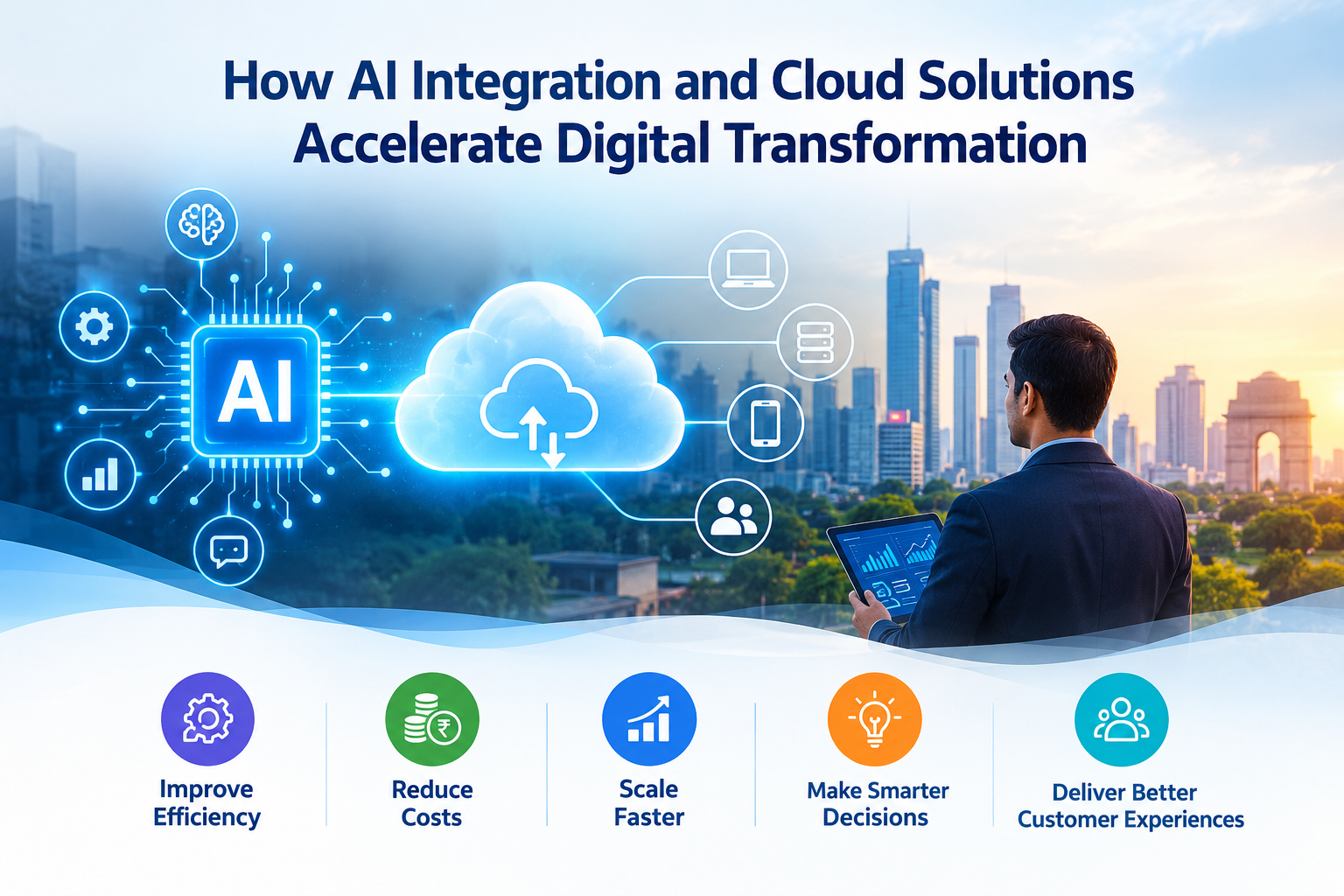
Businesses in India are rapidly moving toward digital-first operations as customers expect faster services, better experiences, and more reliable solutions. AI Integration & Cloud Solutions can help organizations modernize their operations, automate repetitive work, improve decision-making, and build technology infrastructure that can scale with business growth.
Instead of adopting artificial intelligence or cloud computing as isolated technologies, businesses can combine both to create more intelligent, flexible, and scalable digital systems.
What Is Digital Transformation and Why Does It Matter for Indian Businesses?
Digital transformation is the process of using modern digital technologies to improve business operations, customer experiences, decision-making, and overall efficiency. For Indian businesses, this transformation can be particularly valuable as organizations range from growing startups and SMEs to large enterprises with complex systems.
How Is Digital Transformation Changing Indian Businesses?
SMEs and startups can use digital platforms to automate processes and reduce dependence on manual operations. Larger organizations can modernize legacy systems, connect different departments, and use data more effectively.
Traditional industries are also adopting digital tools for areas such as customer service, finance, inventory management, documentation, and internal workflows.
What Challenges Do Businesses Face Without Digital Transformation?
Businesses that continue relying heavily on manual processes may experience:
- Repetitive administrative work
- Fragmented business data
- Higher operational costs
- Limited scalability
- Slow decision-making
- Difficulty delivering consistent customer experiences
AI and cloud technologies can address many of these challenges when implemented according to specific business requirements.
How Does AI Integration Accelerate Digital Transformation?
AI integration allows businesses to introduce intelligent capabilities into existing applications, workflows, and business processes. Rather than simply replacing employees, AI can support teams by handling repetitive tasks and providing useful insights.
How Can AI Automate Repetitive Business Processes?
AI can assist with data processing, document processing, customer support, and workflow automation. For example, organizations dealing with large volumes of documents can use AI-powered systems to extract and organize information more efficiently.
Can AI Improve Business Decision-Making?
Yes. AI can analyze large amounts of business data and identify patterns that may be difficult to detect manually. Predictive analytics, business intelligence, and real-time insights can help decision-makers understand trends and make more informed choices.
How Can AI Improve Customer Experience?
AI-powered chatbots and virtual assistants can provide support around the clock. Businesses can also use AI for personalized recommendations and automated responses, helping customers receive relevant information more quickly.
What Role Does AI-Powered Data Analytics Play?
AI-powered analytics can help Indian businesses turn large volumes of operational data into useful insights. Depending on the business, this may support forecasting, customer analysis, operational monitoring, and performance evaluation.
How Do Cloud Solutions Support Digital Transformation?
Cloud solutions provide the infrastructure businesses need to store data, run applications, support users, and scale digital operations without depending entirely on traditional on-premises infrastructure.
Can Cloud Infrastructure Reduce Upfront IT Investment?
Cloud computing allows businesses to access computing resources according to their requirements. This can make it easier for growing organizations to expand their technology infrastructure without making large investments in physical hardware.
How Does Cloud Storage Improve Data Accessibility?
Cloud-based data storage can allow authorized users and applications to access information from different locations. This is particularly useful for organizations with remote, distributed, or multi-location teams.
How Does Cloud Computing Support Remote Teams?
Cloud-based applications allow employees to work with shared systems and business information from different locations. This can improve collaboration while supporting flexible working environments.
Can Cloud Solutions Improve Business Continuity?
Cloud infrastructure can support backup, recovery, and disaster-recovery strategies. Businesses should still design appropriate backup and security policies based on their specific operational requirements.
How Do AI and Cloud Solutions Work Together?
AI and cloud technologies become especially powerful when they are designed as part of the same digital transformation strategy.
Cloud infrastructure can provide the computing resources and scalable environment required by AI workloads. At the same time, AI can make cloud-hosted applications more intelligent by enabling automation, analytics, prediction, and personalized experiences.
For example, a business could collect operational data through cloud-based applications, process that information using AI, and provide insights through a business dashboard. This creates a connected technology ecosystem rather than separate digital tools.
What Are AI-Powered Cloud Workloads?
AI applications may require significant computing resources, particularly when processing large datasets or running advanced models. Cloud infrastructure can provide scalable resources according to workload requirements.
How Can AI and Cloud Support Real-Time Analytics?
Cloud platforms can centralize business data while AI systems analyze that data to identify patterns and generate insights. This can support faster responses to changing customer and operational requirements.
Can AI and Cloud Build Intelligent Business Applications?
Yes. Businesses can integrate AI capabilities into cloud-based applications to create intelligent customer support systems, analytics platforms, workflow tools, and other custom business applications.
What Are the Key Benefits of AI Integration & Cloud Solutions?
The combination can provide several potential benefits:
- Reduced operational costs: Automation can reduce repetitive manual work.
- Improved productivity: Employees can spend more time on higher-value activities.
- Faster decision-making: AI can help convert business data into actionable insights.
- Better customer engagement: Intelligent support can improve responsiveness.
- Improved scalability: Cloud infrastructure can grow alongside business requirements.
- Stronger data management: Centralized cloud environments can support better organization of business information.
- Competitive advantage: Businesses can respond faster to market and customer changes.
The actual benefits depend on the organization's objectives, existing technology, data quality, and implementation strategy.
Where Can Indian Businesses Use AI and Cloud Solutions?
AI and cloud technologies can be applied across multiple industries.
Healthcare
Potential applications include patient data management, medical documentation, and predictive analytics.
Banking and Financial Services
Financial organizations can use AI for fraud detection, risk analysis, and customer-service automation.
Retail and E-commerce
Retailers can use AI and cloud systems for personalized recommendations, inventory forecasting, customer support, and scalable online operations.
Manufacturing
Manufacturers can explore predictive maintenance, supply-chain optimization, and AI-assisted quality control.
Education
Educational organizations can use personalized learning systems, AI assistants, and cloud-based learning platforms.
IT and Business Services
Service organizations can apply AI to workflow automation, document and data processing, analytics, and intelligent customer support.
AI Integration vs Traditional Business Automation: What's the Difference?
Traditional automation generally follows predefined rules. For example, a system may automatically send an email whenever a specific form is submitted.
AI-powered automation can go further by analyzing information, identifying patterns, understanding natural language, or supporting decisions.
When Should a Business Choose AI?
Businesses should consider AI when there is a clear problem that requires capabilities such as prediction, classification, language processing, intelligent recommendations, or analysis of large datasets.
AI should not be implemented simply because it is currently popular. The technology should solve a measurable business problem.
Can AI Be Integrated Into Existing Business Software?
In many cases, AI can be integrated with existing applications through APIs, custom development, data pipelines, or other integration methods. The appropriate approach depends on the organization's existing architecture and business requirements.
Which Cloud Model Is Right for an Indian Business?
Businesses generally consider public, private, or hybrid cloud approaches.
Public Cloud
Public cloud infrastructure can provide scalability and flexibility and may be suitable for startups and businesses that need resources that can grow quickly.
Private Cloud
Private cloud environments can provide greater control over infrastructure and may be considered for organizations with specific security, governance, or operational requirements.
Hybrid Cloud
A hybrid approach combines elements of public and private environments. It can be useful for organizations that need to maintain certain workloads in controlled environments while using public cloud resources for scalability.
The right model depends on security requirements, workload characteristics, budget, compliance considerations, and existing infrastructure.
How Much Do AI Integration and Cloud Solutions Cost in India?
There is no single fixed price for implementing AI and cloud solutions because project requirements vary considerably.
AI integration costs can depend on:
- Project complexity
- AI models and technologies
- Data volume
- APIs and third-party integrations
- Custom development requirements
Cloud costs may depend on:
- Storage requirements
- Computing resources
- Data transfer
- Security requirements
- Number of users
- Application architecture
Businesses should evaluate total cost of ownership and expected ROI rather than selecting a solution based only on its initial price.
What Should Businesses Consider Before Implementing AI and Cloud?
Before starting a project, businesses should assess their existing IT infrastructure, data quality, cybersecurity requirements, software integrations, employee skills, and future scalability needs.
Vendor experience is also important. A technology provider should understand both the technical requirements and the business objective behind the transformation.
How Can Businesses Choose the Right AI and Cloud Solutions Provider in India?
Businesses should evaluate a provider based on:
- Technical expertise
- AI integration experience
- Cloud implementation experience
- Previous projects and case studies
- Security and data-privacy practices
- Customization capabilities
- Scalability
- Post-implementation support
- Total cost of ownership
The cheapest provider may not always be the most suitable option. Businesses should compare the overall value, technical capabilities, support, and long-term scalability of each solution.
AI and Cloud Implementation Roadmap
A structured implementation process can reduce unnecessary risks.
Step 1: Identify Business Problems and Goals
Define what the organization wants to improve before selecting technology.
Step 2: Audit Existing Systems and Data
Review current software, infrastructure, workflows, integrations, and available data.
Step 3: Select AI and Cloud Technologies
Choose technologies based on actual business requirements rather than trends.
Step 4: Start With a Pilot Project
A smaller pilot can help the organization evaluate performance and business value before wider deployment.
Step 5: Integrate With Existing Systems
Connect the new solution with relevant applications and workflows.
Step 6: Test Security, Performance, and Accuracy
Verify that the system performs reliably and meets appropriate security requirements.
Step 7: Scale Across the Organization
Once the solution demonstrates value, it can be expanded to additional departments, workflows, or locations.
Step 8: Monitor and Optimize
Digital transformation is an ongoing process. Businesses should continuously monitor performance and improve their systems as requirements change.
Common Mistakes Should Businesses Avoid
Organizations should avoid implementing AI without a clear business objective. Choosing technology only because it is inexpensive can also create long-term problems.
Other common mistakes include ignoring data security, migrating to the cloud without adequate planning, failing to train employees, and expecting immediate ROI from AI.
Successful transformation requires technology, planning, people, and continuous improvement.
How Can a Business Choose the Best AI and Cloud Strategy?
| Business Requirement | Recommended Approach |
|---|---|
| Reduce repetitive manual work | AI + workflow automation |
| Need scalable infrastructure | Cloud solutions |
| Large volumes of business data | Cloud + AI analytics |
| Personalized customer experiences | AI integration |
| Existing legacy systems | Gradual cloud migration + AI integration |
| High security requirements | Private or hybrid cloud |
| Fast-growing startup | Public cloud + scalable AI services |
| Enterprise-wide transformation | Integrated AI + hybrid or multi-cloud strategy |
There is no universal solution for every organization. The best approach depends on business size, industry, data, budget, existing infrastructure, security requirements, and long-term goals.
Building a Scalable Digital Future With AI and Cloud
AI provides intelligence, automation, and advanced analytics, while cloud solutions provide the scalable infrastructure needed to support modern digital operations. When implemented together, they can help businesses create more flexible and intelligent systems.
However, successful digital transformation is not about adopting the newest technology. It is about identifying business problems, choosing the right technology, protecting data, integrating existing systems, and measuring business outcomes.
For Indian businesses planning their next stage of digital growth, AI Integration & Cloud Solutions can provide a foundation for building scalable, efficient, and future-ready operations.
Talk to an AI and cloud solutions provider to assess your digital transformation requirements and identify the right technology strategy for your business.
Frequently Asked Questions
Recent Blogs