How to Measure the ROI of E-commerce SEO Services
What Is E-commerce SEO ROI?
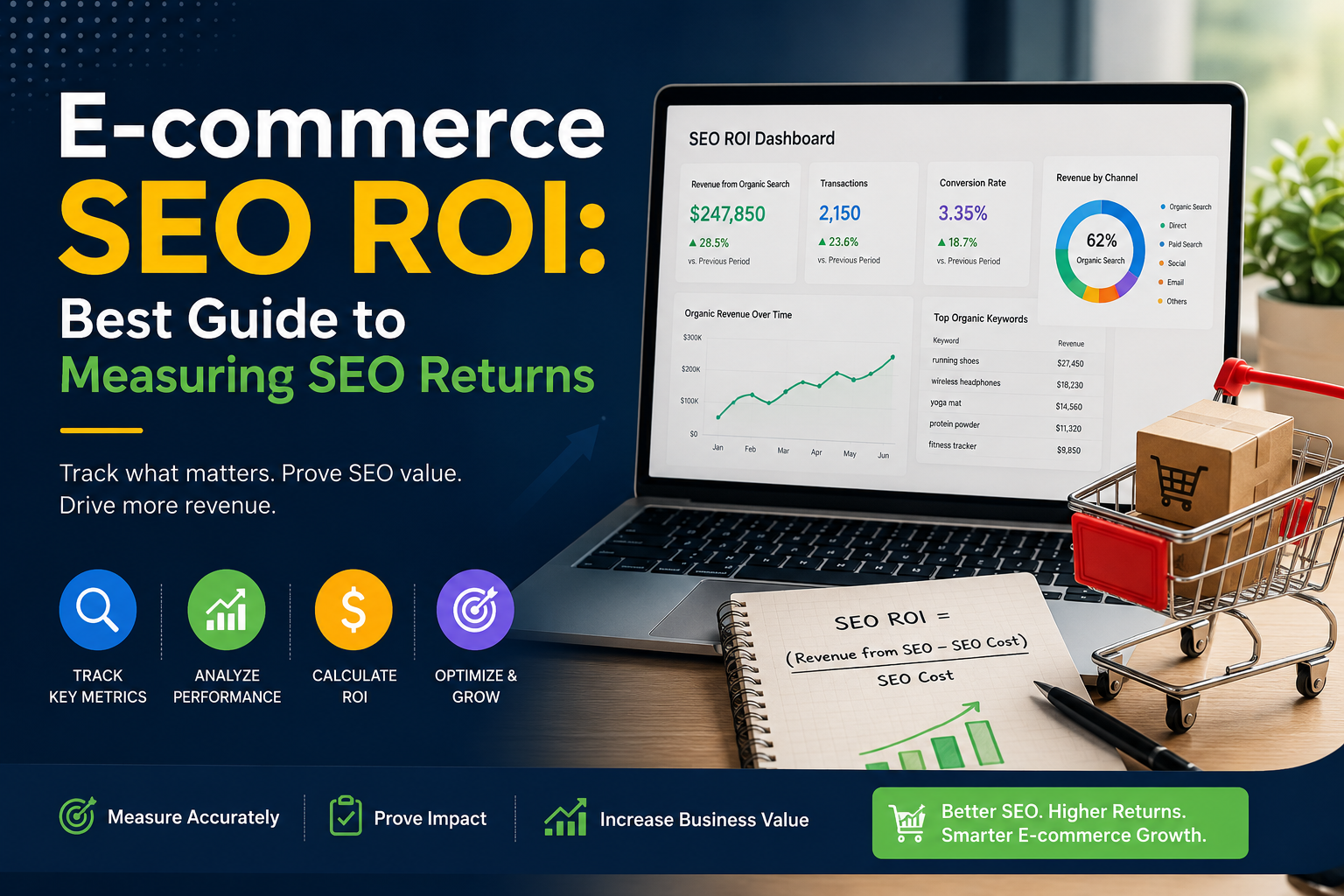
E-commerce SEO ROI measures how much financial value an online store generates from its investment in search engine optimization. Instead of looking only at rankings or organic traffic, ROI connects SEO activity to measurable business outcomes such as organic revenue, completed purchases, average order value, customer acquisition cost, and profit.
For an e-commerce business, this distinction is important. A page ranking well for a high-volume keyword may generate thousands of visitors but very few sales. Another page may attract fewer visitors but produce high-value purchases. Effective E-commerce SEO Services therefore need to be evaluated based on commercial impact, not traffic alone.
A useful starting point is:
SEO ROI = (SEO-attributed revenue − SEO investment) ÷ SEO investment × 100
For example, if an online store invests $10,000 in SEO and generates $30,000 in attributable organic revenue, the gross return is 3x. However, revenue is not the same as profit, so a more accurate analysis should also consider product costs, refunds, discounts, payment fees, and other variable expenses.
Why Should Organic Traffic Be Connected to Revenue?
Traffic, impressions, rankings, and clicks are useful leading indicators. They show whether visibility is improving. However, they do not automatically prove that SEO is generating business value.
A stronger measurement framework connects:
Search visibility → Organic clicks → Product engagement → Add-to-cart actions → Purchases → Revenue → Profit
This approach helps businesses understand which SEO activities actually contribute to growth.
What Is the Correct Formula for E-commerce SEO ROI?
What Is the Standard SEO ROI Formula?
The basic formula is:
Gross SEO ROI = (Organic Revenue − SEO Cost) ÷ SEO Cost
If SEO produces $50,000 in attributable revenue from a $15,000 investment:
($50,000 − $15,000) ÷ $15,000 = 2.33
This means the campaign generated approximately 2.33x return after accounting for the SEO investment.
Why Is Net SEO ROI More Accurate?
Net ROI can provide a more realistic picture because e-commerce revenue includes costs that do not become profit.
A practical calculation can include:
- Cost of goods sold
- Refunds and returns
- Discounts
- Transaction fees
- Fulfilment costs
- SEO agency or specialist fees
- Content production
- Technical development
- SEO software and tools
The result is a profit-oriented measurement rather than a simple revenue calculation.
How Do You Calculate the Total SEO Investment?
What Costs Should Be Included?
The first step is to calculate the complete cost of SEO.
Include direct costs such as:
- SEO strategy and consulting
- Content creation
- Technical SEO implementation
- Link acquisition and digital PR
- SEO software
- Keyword research tools
- Analytics and reporting
- Developer resources
- Design and conversion optimization
If employees spend part of their working time on SEO, allocate the appropriate percentage of their salaries or hourly costs.
For example, if a developer spends 20% of their monthly working time implementing SEO improvements, 20% of their relevant monthly cost should be included in the SEO investment calculation.
This prevents businesses from underestimating what SEO actually costs.
How Do You Track Organic E-commerce Revenue?
How Should Analytics Be Configured?
Reliable ROI measurement starts with accurate analytics.
Your analytics setup should record:
- Organic sessions
- Product views
- Add-to-cart events
- Checkout activity
- Completed purchases
- Purchase value
- Average order value
- New and returning customers
- Organic conversion rate
- Revenue by landing page
E-commerce purchase tracking should be configured carefully so that revenue is attributed to the correct traffic source.
Micro-conversions are also valuable. An SEO landing page may not generate an immediate purchase but could produce product views, wishlist actions, account registrations, or add-to-cart activity.
Why Are Assisted Conversions Important?
Customers rarely follow a single-channel journey.
A shopper might:
- Discover a product through organic search.
- Read an informational article.
- Return through direct traffic.
- Compare products.
- Purchase several days later.
If you only credit the final interaction, SEO may appear less valuable than it actually is.
A multi-touch attribution approach can assign a proportion of the eventual conversion value to earlier organic interactions.
What Is a Good E-commerce SEO ROI?
There is no universal ROI number that applies to every store. Product margins, competition, website quality, brand strength, average order value, conversion rate, and SEO investment can all change the result.
One widely cited 2026 industry benchmark based on research across e-commerce clients reports an average ROI progression of approximately 0.8x at six months, 2.6x at 12 months, 3.8x at 18 months, 4.6x at 24 months, and 5.2x at 36 months or longer.
These figures should be treated as benchmarks, not guarantees.
How Does SEO ROI Change Over Time?
SEO normally requires an initial investment period.
6 months: Early technical improvements and quick wins may produce limited returns.
12 months: Content, internal linking, technical improvements, and authority can begin producing stronger commercial results.
18 months: Established rankings and accumulated content can increase organic revenue.
24 months: Mature pages may continue generating revenue without requiring the same level of initial investment.
36+ months: The cumulative effect of established organic visibility can create stronger returns.
The key lesson is that SEO should generally be evaluated over an appropriate time horizon rather than judged after a few weeks.
Which E-commerce Categories Can Generate Strong SEO Returns?
SEO performance varies considerably by vertical.
The cited 2026 benchmark research reports specialty retail at approximately 4.2x ROI and apparel and fashion at approximately 2.8x at the relevant benchmark horizon.
The difference can be influenced by:
- Search demand
- Competition
- Product margins
- Purchase intent
- Content opportunities
- Return rates
- Average order value
- Customer lifetime value
Therefore, businesses should compare their results against relevant market conditions instead of applying one universal benchmark.
How Does Company Size Affect SEO ROI?
Company size can also influence SEO efficiency.
Larger organizations may have more resources but often face complex approval processes, technical dependencies, and larger websites.
Smaller stores may move faster but have limited budgets and fewer resources.
A 2026 industry analysis reports stronger ROI for some mid-market e-commerce businesses compared with smaller and enterprise segments, highlighting how budget, execution speed, website complexity, and available resources can influence results.
For this reason, the right question is not simply, "What is the average SEO ROI?"
A better question is:
"What return should our SEO investment generate based on our margins, traffic potential, conversion rate, and business model?"
How Does SEO Compare With Paid E-commerce Marketing?
.png)
SEO and paid search work differently.
Paid advertising can provide immediate traffic when budget is available. SEO generally requires a longer development period but can continue producing organic visibility after individual pages are created and optimized.
One cited benchmark places e-commerce SEO at approximately 3.2x ROI compared with 1.9x for paid search, although measurement methods and business conditions can vary.
The important distinction is the cost structure.
Paid traffic generally requires continuing advertising expenditure for continued exposure. SEO investment can create reusable assets such as:
- Category pages
- Product pages
- Buying guides
- Comparison content
- Helpful FAQs
- Internal linking structures
- Technical improvements
These assets can continue attracting organic users over time.
How Can You Forecast E-commerce SEO ROI Before Starting?
How Do You Estimate Future Organic Traffic?
Begin with keyword research and competitor analysis.
Estimate:
- Monthly search demand.
- Relevant keywords.
- Potential ranking positions.
- Expected organic click-through rate.
- Organic conversion rate.
- Average order value.
- Expected revenue.
- SEO investment.
A simple forecasting model is:
Estimated Revenue = Organic Visits × Conversion Rate × Average Order Value
For example, if SEO generates 20,000 relevant monthly visitors, the conversion rate is 2%, and average order value is $80:
20,000 × 0.02 × $80 = $32,000
This is a forecast, not a guarantee. Actual click-through rates vary significantly depending on search intent, SERP features, competition, device, brand recognition, and ranking position.
Industry research also emphasizes using realistic CTR assumptions rather than treating ranking position as a guaranteed percentage of clicks.
How Should Visual Search and Generative AI Be Included in SEO ROI?
Modern search behavior extends beyond traditional blue-link rankings.
E-commerce businesses should increasingly monitor visibility across:
- AI-generated search experiences
- Conversational search
- Product discovery systems
- Visual search
- Image results
- Product recommendations
- Entity-based search experiences
This creates a broader measurement challenge.
Not every customer interaction will be captured as a traditional organic click. Businesses should therefore monitor branded search growth, assisted conversions, referral patterns, product discovery, direct traffic changes, and conversion behavior alongside conventional SEO metrics.
For E-commerce SEO Services, the objective should be broader than ranking for keywords. The goal is to make products, categories, and useful information discoverable wherever potential customers search.
How Do You Report SEO ROI to Business Stakeholders?
A strong SEO report should focus on commercial outcomes rather than a long list of technical metrics.
A useful monthly report can include:
Revenue Metrics
- Organic revenue
- Organic transactions
- Revenue per visitor
- Average order value
- Organic conversion rate
Investment Metrics
- Total SEO cost
- Cost per organic acquisition
- Content investment
- Technical implementation cost
Visibility Metrics
- Organic clicks
- Search impressions
- Ranking distribution
- Non-brand visibility
- Product and category visibility
Business Impact
- New customers
- Returning customers
- Assisted conversions
- Customer lifetime value
- Revenue contribution
The most useful reporting question is:
"How much business value did SEO generate compared with what we invested?"
That question turns SEO reporting from a ranking report into a business performance report.
How Can Voicene Technologies LLP Help With E-commerce SEO Services?
Voicene Technologies LLP approaches digital solutions with a focus on measurable business outcomes, scalable technology, analytics, and intelligent automation.
For an e-commerce business, SEO measurement can be strengthened by connecting search performance with website behavior, conversion data, product information, and business reporting.
You can also explore the company's AI Software Development Services when advanced automation, analytics, or intelligent digital solutions are part of your growth strategy.
A well-designed SEO measurement system should make it easier to identify which pages generate revenue, which search terms attract valuable customers, and where additional investment can create the greatest business impact.
Conclusion
Measuring e-commerce SEO ROI requires more than tracking rankings or organic traffic. The strongest measurement framework connects SEO investment with organic conversions, revenue, profit, customer value, and assisted conversions.
SEO should be evaluated as a long-term growth investment. Industry benchmark research shows that returns can increase substantially as organic visibility, content assets, authority, and conversion opportunities compound over time.
For businesses investing in E-commerce SEO Services, the goal should be clear: build measurable organic visibility, connect that visibility to commercial outcomes, and continuously improve the pages and search journeys that contribute to revenue.
Frequently Asked Questions About E-commerce SEO ROI
Recent Blogs