Top Benefits of AI Chatbots for Business Growth
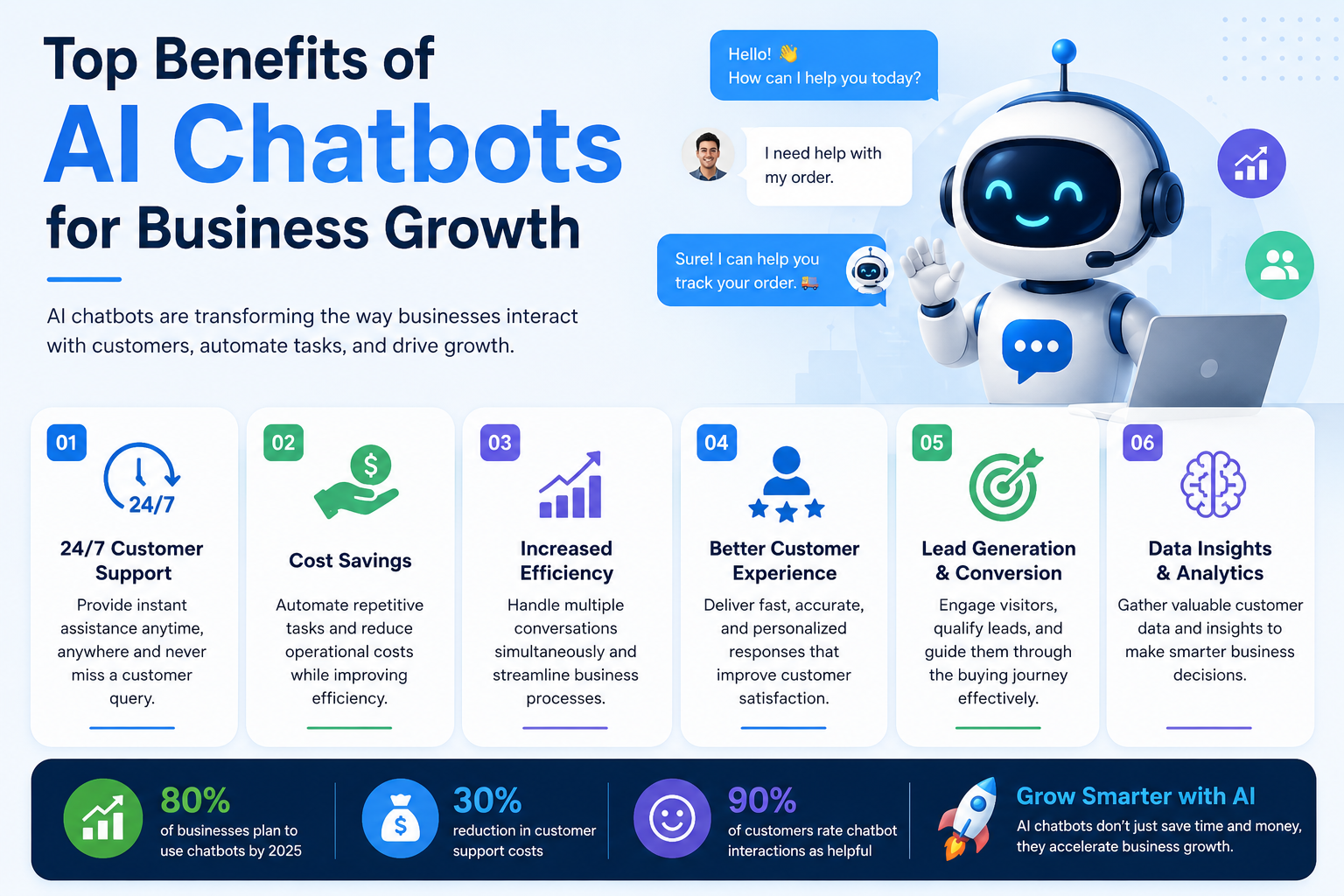
Businesses are increasingly using AI chatbots for business growth to improve customer service, automate repetitive tasks, generate leads, and provide faster digital assistance. Unlike traditional scripted chatbots, modern AI-powered systems can understand natural language, recognize user intent, maintain conversation context, and provide relevant responses.
For businesses looking to improve efficiency while delivering better customer experiences, AI chatbots can become an important part of a modern digital strategy. From 24/7 customer support to sales assistance and employee self-service, conversational AI can support multiple areas of business operations.
Voicene Technologies LLP, an AI-focused software development company headquartered in Thiruvananthapuram, Kerala, develops AI solutions designed around practical business requirements and customer needs.
What Is an AI Chatbot?
An AI chatbot is a software application that uses artificial intelligence to communicate with users through text or voice. It can understand questions, identify user intent, retrieve relevant information, and provide conversational responses.
Modern chatbots use technologies such as Natural Language Processing (NLP), Natural Language Understanding (NLU), Machine Learning (ML), and Generative AI. These technologies enable chatbots to handle conversations more naturally than traditional rule-based systems.
For example, instead of forcing a customer to select several menu options to check an order, an AI chatbot can understand a question such as, “Can you tell me where my order is?” and determine the appropriate response.
How Are AI Chatbots Different From Traditional Chatbots?
Traditional chatbots generally depend on predefined scripts, buttons, keywords, and decision trees. They work well for simple and predictable conversations but can struggle when users ask questions differently from the programmed flow.
AI chatbots are more flexible. They can interpret different ways of asking the same question and use conversational context to provide more relevant answers.
This makes AI chatbots for business growth useful for customer support, lead qualification, product assistance, employee support, and other business processes.
What Are the Benefits of AI Chatbots for Business Growth?
How Can AI Chatbots Provide 24/7 Customer Support?
One of the biggest benefits of AI chatbots is continuous availability. A chatbot can respond to customer questions at any time, including outside normal business hours.
Customers can receive immediate answers to common questions about products, services, pricing, availability, delivery, policies, and other routine topics.
This reduces waiting times and gives businesses an opportunity to engage customers even when human support teams are unavailable.
Can AI Chatbots Reduce Customer Support Workloads?
Yes. AI chatbots can handle repetitive questions that would otherwise require support employees to respond manually.
Common automated tasks can include:
- Answering frequently asked questions
- Providing basic product information
- Checking order or service information
- Explaining policies and procedures
- Collecting customer details
- Directing customers to the appropriate department
- Providing basic troubleshooting guidance
By automating suitable interactions, employees can dedicate more time to complex customer issues that require human judgment.
How Do AI Chatbots Help Generate Leads?
AI chatbots can interact with website visitors and potential customers throughout the buying journey.
For example, a chatbot can ask visitors about their requirements, identify their interests, answer initial questions, collect contact information, and direct qualified prospects toward the next step.
This makes conversational AI useful for businesses that want to improve website engagement and lead-generation processes.
Can AI Chatbots Improve Customer Experience?
Speed and convenience are important parts of a good digital customer experience. Customers often want answers without waiting for an email response or searching through multiple pages.
AI chatbots can provide immediate assistance and guide customers toward relevant information. When properly designed, they can create a smoother journey from the first interaction through support and follow-up.
Personalized conversations can also make digital interactions more relevant to individual customer requirements.
How Do AI Chatbots Improve Employee Productivity?
AI chatbot technology is not limited to external customers. Businesses can also use conversational systems to support employees.
AI chatbots virtual assistance can help employees find internal information, access frequently requested policies, submit routine requests, and receive basic IT or HR assistance.
This reduces repetitive administrative work and allows employees to focus on higher-value responsibilities.
How Can AI Chatbots Be Used in Different Industries?
How Can Businesses Use AI Chatbots in E-Commerce?
E-commerce businesses can use AI chatbots as digital shopping assistants. They can help customers discover products, answer questions, provide recommendations, explain delivery information, and assist after a purchase.
A chatbot can also guide customers through product comparisons and help them find options based on their requirements.
How Can Financial Businesses Use AI Chatbots?
Financial organizations can use chatbots to provide general service information, answer frequently asked questions, guide customers through applications, and support routine inquiries.
Because financial information can be sensitive, authentication, authorization, security controls, and appropriate human escalation should be considered when designing these solutions.
How Can Healthcare Organizations Use AI Chatbots?
Healthcare organizations can use AI chatbots for administrative and informational tasks such as appointment scheduling, onboarding, service information, and frequently asked questions.
AI chatbots should not replace qualified healthcare professionals. Sensitive or high-risk conversations should be transferred to appropriate human professionals.
Can AI Chatbots Support HR and IT Teams?
Yes. Internal AI assistants can help employees quickly find company information and complete routine requests.
For example, an employee could ask about a workplace policy or request basic technical guidance through a conversational interface rather than contacting a support team for every simple question.
This is another practical application of AI chatbots virtual assistance.
What Challenges Should Businesses Consider Before Implementing AI Chatbots?
Although AI chatbots offer many benefits, businesses should consider accuracy, security, privacy, integration, and user experience before deployment.
How Can Businesses Reduce Incorrect AI Responses?
AI systems can sometimes produce inaccurate or incomplete responses. Businesses can reduce this risk by connecting chatbots to trusted information sources, establishing clear response rules, testing common scenarios, monitoring conversations, and introducing human escalation.
The chatbot should also be designed to acknowledge when it does not have enough information instead of providing an unreliable answer.
How Important Is Data Privacy for AI Chatbots?
Data privacy should be considered from the beginning of an AI chatbot project.
Businesses should determine what information is collected, how it is processed, where it is stored, who can access it, and how long it is retained.
Appropriate security measures, access controls, encryption, monitoring, and data-handling policies can help protect sensitive information.
What Are the Best Practices for AI Chatbot Implementation?
.png)
Should Chatbots Be Designed Around User Intent?
Yes. Businesses should focus on real customer questions and business objectives rather than simply creating a large list of keywords.
Before development, it is useful to identify:
- Common customer questions
- Repetitive support requests
- Sales opportunities
- Frequently requested information
- Employee support requirements
- Situations requiring human intervention
This approach helps create a chatbot that solves actual problems.
Should AI Chatbots Include Human Handoff?
A human handoff is an important part of a reliable chatbot experience.
If a customer has a complex, sensitive, or unusual request, the chatbot should be able to transfer the conversation to a human representative.
A well-designed hybrid approach combines AI automation with human expertise, giving customers faster responses without removing the human element from important interactions.
How Can Businesses Measure AI Chatbot Performance?
Businesses should measure the results of their chatbot rather than relying only on the number of conversations.
Important KPIs include:
- Chatbot containment rate
- Customer Satisfaction (CSAT)
- First Contact Resolution (FCR)
- Average response time
- Escalation rate
- Lead conversion rate
- Number of qualified leads
- Resolution time
- Cost per customer interaction
- Customer engagement
The containment rate measures how many conversations are successfully resolved by the chatbot without human intervention.
However, a high containment rate should always be evaluated alongside customer satisfaction and resolution quality. A chatbot that prevents human escalation by giving poor answers is not delivering meaningful business value.
Why Should Businesses Invest in AI Chatbots?
The value of AI chatbots for business growth comes from their ability to combine automation, customer engagement, and operational efficiency.
A well-designed chatbot can help businesses:
- Provide 24/7 customer assistance
- Respond to customers instantly
- Automate repetitive questions
- Improve lead engagement
- Support sales conversations
- Reduce employee workloads
- Provide multilingual assistance
- Improve access to business information
- Deliver more consistent customer experiences
The goal should not be to automate every interaction. Instead, businesses should identify areas where AI can provide genuine value while allowing human employees to handle conversations that require expertise, empathy, or decision-making.
How Can Voicene Technologies Help With AI Chatbot Development?
Voicene Technologies LLP develops AI-focused software solutions based on specific business objectives and operational requirements.
An effective chatbot project begins with understanding the target audience, business processes, customer questions, available information, security requirements, and desired outcomes.
Whether the objective is customer support, lead generation, employee assistance, product discovery, or workflow automation, an AI chatbot can be designed around the organization's unique requirements.
With the right strategy, AI chatbots for business growth can become more than a customer-support tool. They can serve as an intelligent digital interface that connects customers, employees, information, and business processes.
Conclusion
AI chatbot technology is becoming an important tool for businesses that want to improve digital customer experiences and operational efficiency. From 24/7 assistance and lead generation to employee self-service and automated support, there are many practical applications.
The most successful chatbot implementations focus on real business needs, reliable information, data protection, measurable KPIs, and seamless human handoff.
For businesses exploring AI chatbots for business growth, Voicene Technologies can help transform specific business requirements into practical AI-powered software solutions designed for scalability, efficiency, and better digital engagement.
Frequently Asked Questions About AI Chatbots
Recent Blogs