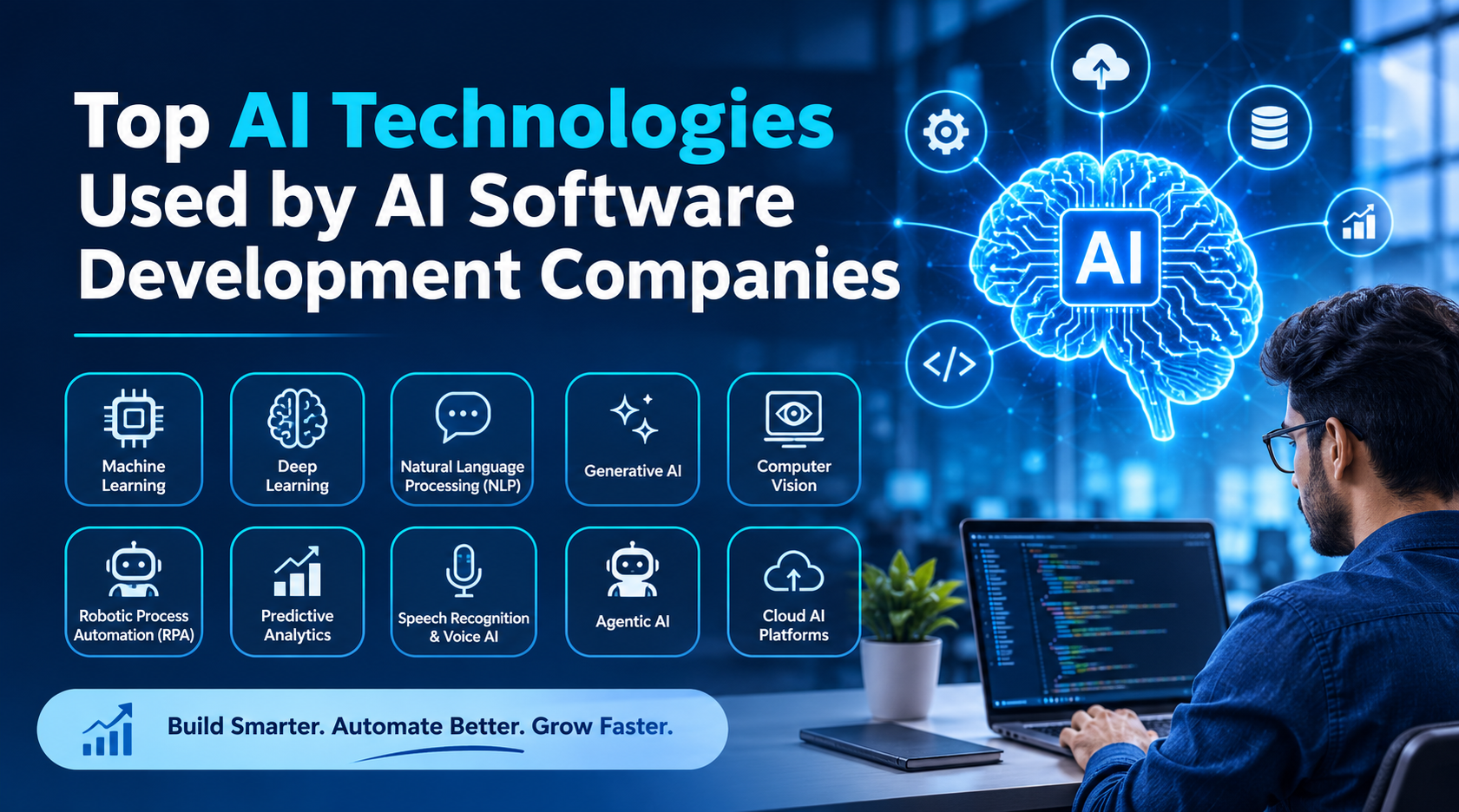
Top AI Technologies Used by AI Software Development Companies
Artificial intelligence is transforming how businesses operate, communicate with customers and manage everyday processes. Across India, organisations are adopting intelligent software to improve productivity, analyse business information and automate repetitive tasks. An AI software development company uses advanced technologies such as machine learning, natural language processing, computer vision and generative AI to create applications that address specific business requirements.
Choosing the right AI technology is important because every business has different operational challenges. Some organisations need intelligent customer support, while others require predictive analytics, automated document processing or advanced data management. The right combination of technologies can improve decision-making, simplify workflows and create better digital experiences. Understanding the available technologies helps businesses make informed decisions before investing in AI development.
What Are the Main AI Technologies Used in Software Development?
AI software development combines different technologies to build applications that can analyse information, recognise patterns, understand language and perform tasks intelligently. Each technology serves a particular purpose and can be integrated with existing business systems.
1. Machine Learning (ML)
Machine learning enables software applications to learn from historical data and identify patterns without requiring developers to programme every decision manually. It is widely used in business forecasting, customer segmentation, fraud detection and recommendation systems.
The three major approaches include:
- Supervised learning: Uses labelled datasets to predict outcomes, such as customer purchases and sales performance.
- Unsupervised learning: Identifies hidden patterns and groups within large datasets.
- Reinforcement learning: Helps systems improve decisions through feedback and rewards.
Indian businesses can use machine learning to understand customer behaviour, forecast inventory requirements and identify unusual financial transactions.
2. Deep Learning (DL)
Deep learning is an advanced branch of machine learning that uses artificial neural networks to process complex information. It is particularly useful when applications need to understand images, audio, video and large volumes of unstructured data.
Important deep learning architectures include:
- Artificial Neural Networks (ANN)
- Convolutional Neural Networks (CNN)
- Recurrent Neural Networks (RNN)
- Transformer architecture
These technologies support applications such as medical image analysis, speech processing, advanced recommendation engines and intelligent document recognition.
3. Natural Language Processing (NLP)
Natural Language Processing allows computers to understand, interpret and generate human language. It plays an important role in applications that interact with customers or process written information.
Common NLP applications include sentiment analysis, automated email classification, language translation, text summarisation and customer support chatbots.
For Indian businesses, multilingual capabilities are particularly valuable. NLP applications can support languages such as Malayalam, Hindi and Tamil, helping organisations communicate with customers across different regions.
4. Generative AI and Large Language Models (LLMs)
Generative AI creates new content based on patterns learned from training data. Large Language Models process and generate human-like text, making them useful for business communication, information retrieval and intelligent assistance.
Popular models and model families used in AI development include GPT, Gemini, Claude and Llama.
Businesses can integrate these models into applications to support:
- Automated customer service.
- Business document summarisation.
- Content and report generation.
- Internal knowledge management.
- Intelligent virtual assistants.
Retrieval-Augmented Generation (RAG) is another important approach. It connects language models with relevant business documents or databases so that responses can be grounded in an organisation's available information.
5. Computer Vision
Computer vision enables software to interpret visual information from images and videos. It helps applications recognise objects, identify patterns and extract useful information from visual content.
Major applications include:
- Image recognition and object detection.
- Facial recognition and identity verification.
- Optical Character Recognition (OCR).
- Manufacturing quality inspection.
- Warehouse and inventory monitoring.
Manufacturing companies can use computer vision to identify product defects, while retailers can apply image recognition to improve product categorisation and inventory management.
6. Robotic Process Automation (RPA)
RPA automates repetitive, rule-based business activities through software bots. When combined with AI, it can handle more complex workflows involving document interpretation, data extraction and decision support.
Examples include invoice processing, employee record updates, customer information management and automated report preparation.
7. Predictive Analytics
Predictive analytics uses historical information, statistical techniques and machine learning models to estimate future outcomes. Businesses can use it to forecast sales, identify customer trends, predict equipment maintenance requirements and improve resource planning.
8. Speech Recognition and Voice AI
Speech recognition converts spoken language into digital text, while text-to-speech technologies generate spoken responses from written content. These capabilities support voice assistants, automated call handling, transcription systems and multilingual customer service applications.
How Machine Learning Technologies Support Business Automation
Machine learning helps organisations move beyond traditional software that follows fixed instructions. By analysing historical and incoming data, applications can identify patterns and generate predictions that support everyday business decisions.
For example, an e-commerce business can analyse previous purchases to identify products customers may be interested in. A financial organisation can examine transaction patterns to flag potentially suspicious activities.
Some practical applications include:
- Customer behaviour prediction: Identifies purchasing patterns and customer preferences.
- Inventory forecasting: Estimates product demand and supports stock planning.
- Sales prediction: Analyses historical sales information to support business planning.
- Customer segmentation: Groups customers according to relevant behavioural patterns.
- Fraud detection: Identifies unusual transactions that may require further investigation.
The effectiveness of machine learning depends on data quality, appropriate model selection and continuous performance evaluation. Businesses should also consider human oversight when predictions influence important decisions.
Generative AI and Large Language Models for Intelligent Applications
Generative AI is changing how organisations access information and manage communication. Instead of relying entirely on manual processes, businesses can integrate language models into their software to assist employees and customers.
For example, an internal knowledge assistant can retrieve information from approved company documents. A customer support application can generate responses based on product information and predefined service guidelines.
RAG architecture improves this process by retrieving relevant information from connected knowledge sources before generating a response. This approach is useful when businesses need answers based on internal documents rather than general model knowledge.
However, generative AI applications require appropriate safeguards. Developers should consider access permissions, confidential information, response accuracy, data retention and human review before deploying them in business environments.
Agentic AI and Intelligent AI Agents
Agentic AI introduces systems that can plan tasks, use approved tools and complete multiple steps towards a defined objective. Unlike a basic chatbot that primarily responds to individual prompts, an AI agent can coordinate a sequence of activities within established permissions.
For example, an agent may retrieve information from an authorised database, prepare a summary and send it for employee approval. Multiple agents can also work together, with each handling a specific part of a larger workflow.
Important applications include customer service coordination, business research, document processing and workflow management.
For Indian enterprises, agentic AI can help connect different business applications and reduce repetitive administrative work. However, permissions, monitoring and approval mechanisms remain essential, particularly when agents interact with financial records or customer information.
Predictive Analytics and Business Intelligence Technologies
Predictive analytics connects historical data with intelligent models to support better business planning. It helps organisations understand what has happened, identify current patterns and estimate possible future outcomes.
Common applications include:
- Demand forecasting: Estimates future product and service requirements.
- Customer analytics: Identifies changes in customer interests and purchasing behaviour.
- Predictive maintenance: Detects potential equipment problems before major breakdowns occur.
- Business reporting: Organises operational information into useful reports and insights.
- Performance analysis: Helps management teams evaluate business activities.
When combined with business intelligence dashboards, predictive analytics makes complex information easier to understand. Retailers, manufacturers, logistics providers and financial organisations can use these insights to plan resources more effectively.
Computer Vision and Intelligent Document Processing
Computer vision is especially useful for industries that work with large volumes of images, scanned documents and video information.
Optical Character Recognition extracts text from documents, while intelligent document processing combines OCR with AI techniques to classify information and identify relevant fields.
For example, an organisation can use document processing to extract invoice numbers, dates, customer details and transaction values. These details can then be transferred into an authorised business application for verification.
Manufacturing companies can use image analysis for quality inspection, while healthcare organisations may use specialised computer vision systems to assist with medical image analysis. Such applications must be designed with appropriate accuracy testing and industry-specific safeguards.
Cloud AI Platforms and Development Frameworks
Building an AI application requires more than selecting a machine learning model. Developers also need suitable infrastructure, frameworks, APIs and deployment environments.
Cloud-Based AI Development Platforms
Popular cloud platforms provide infrastructure and services for building, training and deploying AI applications.
- AWS AI services: Offers cloud infrastructure and AI services for application development and deployment.
- Microsoft Azure AI: Provides tools for integrating AI capabilities into enterprise applications.
- Google Cloud AI: Supports machine learning development, model deployment and data-driven applications.
Popular AI Development Frameworks
Several development frameworks support different stages of AI implementation.
| Framework | Primary application |
|---|---|
| TensorFlow | Machine learning and deep learning development |
| PyTorch | Neural network development and model experimentation |
| Scikit-learn | Traditional machine learning and predictive modelling |
| Hugging Face | Language models, transformers and NLP applications |
Developers may also integrate third-party AI APIs to add capabilities such as language processing, image recognition and speech generation.
MLOps and AI Model Deployment Technologies
Developing an AI model is only one part of a successful software project. After development, the model must be tested, deployed, monitored and maintained.
MLOps combines machine learning development with software engineering and operational practices. It helps teams manage the complete model lifecycle.
Important activities include:
- Model training and testing: Evaluating performance using suitable datasets.
- Model deployment: Integrating trained models into business applications.
- Performance monitoring: Tracking accuracy, response time and changing data patterns.
- Model version management: Maintaining records of model updates and configurations.
- Continuous improvement: Retraining and optimising models when business requirements or data change.
A structured MLOps process helps businesses maintain reliable AI applications as their operations expand.
How AI Technologies Benefit Different Industries in India
AI adoption is not limited to technology companies. Different industries can apply intelligent software to solve practical operational challenges.
Healthcare and Medical Services
Healthcare organisations can use AI for medical document processing, patient information management, administrative workflow automation and specialised image analysis. These applications can support healthcare professionals, provided appropriate clinical validation and privacy safeguards are maintained.
Banking and Financial Services
Financial institutions can apply machine learning to transaction monitoring, fraud detection, risk assessment and financial data analysis. AI systems can identify unusual patterns and support human decision-making.
Manufacturing and Industrial Businesses
Manufacturers can use predictive maintenance, computer vision and production analytics to monitor equipment, identify quality issues and improve production planning.
Retail and E-commerce
Retail businesses can implement personalised recommendations, customer behaviour analytics, automated customer support and inventory forecasting to improve their digital operations.
Logistics and Transportation
AI-powered applications can support route optimisation, fleet monitoring, delivery forecasting and resource allocation. These technologies are particularly useful for organisations managing large transportation networks.
IT and Business Process Outsourcing
IT and BPO organisations can use NLP, RPA and generative AI for automated data processing, multilingual customer support, document management and business reporting.
How to Choose the Right AI Technology for Your Business
Selecting an AI technology should begin with a clear understanding of the business problem. Implementing advanced tools without identifying a practical requirement can create unnecessary complexity.
Consider the following factors before starting development:
- Business objectives: Identify whether the priority is automation, forecasting, customer engagement or data analysis.
- Data availability: Check whether the organisation has sufficient, accurate and relevant information.
- Existing infrastructure: Evaluate compatibility with current CRM, ERP, databases and business applications.
- Scalability: Select technologies that can support increasing users, data volumes and operational requirements.
- Security and privacy: Establish access controls, data protection measures and appropriate governance.
- Maintenance requirements: Consider model monitoring, software updates, technical support and future integration needs.
A small pilot project can help organisations evaluate feasibility before expanding AI implementation across multiple departments.
How to Select the Right AI Software Development Company in India
Choosing a development partner is an important step because AI projects require a combination of software engineering, data management and machine learning expertise.
Evaluate potential development companies using these criteria:
- Technical expertise: Review their knowledge of machine learning, NLP, computer vision, generative AI and cloud technologies.
- Previous projects: Examine relevant case studies, project portfolios and experience with similar business requirements.
- Development capabilities: Understand how the team approaches software architecture, API integration, model development and testing.
- Data security: Check how confidential information, user permissions and application access are managed.
- Scalability: Ensure the proposed architecture can accommodate future business growth and additional functionality.
- Post-development support: Discuss maintenance, monitoring, troubleshooting and model optimisation after deployment.
A suitable technology partner should understand the organisation's requirements before recommending a specific AI model or development framework.
AI Software Development Trends Shaping Business Innovation
The AI landscape continues to evolve as businesses explore more practical ways to integrate intelligence into their applications. Several AI software development trends are influencing how modern software is designed and implemented.
Some important developments include:
- Generative AI integration: More applications are incorporating language and content generation capabilities.
- Agentic AI: Intelligent agents are being developed to coordinate multi-step business workflows.
- Multimodal AI: Models can work with combinations of text, images, audio and other information formats.
- Edge AI: Processing closer to connected devices can support applications requiring faster local responses.
- Responsible AI: Greater attention is being given to transparency, privacy, security and human oversight.
- AI-powered automation: Businesses are combining RPA, machine learning and language models to manage complex processes.
These developments provide new opportunities, but technology selection should always be based on practical business requirements rather than trends alone.
Top Benefits of AI Software Development Services
Investing in suitable AI solutions can help businesses improve how they manage information, interact with customers and organise internal operations.
The Top Benefits of AI Software Development Services include:
- Improved operational efficiency: Automates repetitive activities and reduces manual processing.
- Better decision-making: Uses business data to identify patterns and generate useful insights.
- Enhanced customer experience: Supports personalised communication and intelligent assistance.
- Greater data utilisation: Helps organisations extract useful information from structured and unstructured datasets.
- Scalable business operations: Supports the development of applications that can adapt to changing requirements.
- Workflow optimisation: Connects different software systems and simplifies routine business activities.
- Continuous improvement: Allows AI applications to be monitored, evaluated and updated as requirements evolve.
The actual benefits depend on implementation quality, data availability, business processes and the suitability of the selected technology.
Choosing the Right AI Technologies for Business Growth
Artificial intelligence offers multiple technologies that help businesses automate processes, understand information and improve digital experiences. Machine learning, deep learning, NLP, generative AI, computer vision, predictive analytics and intelligent automation each serve different purposes. The right combination depends on the organisation's objectives, available data, infrastructure and long-term requirements.
Businesses should evaluate technical expertise, application security, integration capabilities and maintenance needs before beginning an AI project. Working with a reliable AI software development company can help organisations plan and implement solutions that support sustainable business growth. Explore suitable AI development capabilities and take the next step towards building intelligent business applications.
Looking to integrate artificial intelligence into your business applications? Contact our team to discuss your AI software development requirements, intelligent automation opportunities and technology integration needs.
Frequently Asked Questions (FAQs)
1. What are the most popular AI technologies used in software development?
The most popular AI technologies include machine learning, deep learning, natural language processing, generative AI, computer vision, predictive analytics and robotic process automation. These technologies help businesses develop intelligent applications, automate workflows and improve decision-making.
2. Which AI technology is best for business automation?
Machine learning, generative AI and robotic process automation are widely used for business automation. Machine learning supports data-driven decisions, generative AI assists with information processing, and RPA automates repetitive tasks. The right choice depends on business requirements.
3. What is the difference between machine learning and generative AI?
Machine learning analyses data to identify patterns, make predictions and support decisions. Generative AI uses learned patterns to create new content, including text, images and code. Both technologies can work together in intelligent business applications.
4. How do AI software development companies use large language models?
AI software development companies integrate large language models into applications to support chatbots, virtual assistants, document summarisation, content generation and internal knowledge management. Technologies such as RAG can connect these models with relevant business information.
5. Which AI technologies are suitable for Indian startups?
Indian startups can benefit from machine learning, generative AI, NLP, cloud-based AI platforms and intelligent automation. These technologies can support customer service, sales forecasting, multilingual communication and operational efficiency while allowing businesses to scale their applications as requirements grow.
Recent Blogs